If you’re wondering how to choose a pool cover, the first thing to know is that there isn’t one cover that’s best for every pool. A solar pool cover can be excellent for keeping heat in and reducing evaporation, while a stronger safety cover may be more appropriate if physical protection and security are priorities.
The right choice depends on what you actually want the cover to do: retain heat, reduce evaporation, keep leaves out, make the pool easier to maintain, improve safety, or some combination of these.
For most NZ pool owners, I’d start by looking at how often you use the pool, how much sun and wind it gets, whether heating is involved, how much debris gets into it, and how practical the cover will be to put on and take off.
There’s also an important distinction between an ordinary pool cover and a safety cover. A typical solar or bubble cover should never be assumed to be a child-safety barrier.
What to consider before buying a pool cover
Before comparing different swimming pool covers, think about these questions:
- Do you mainly want to keep the pool warm?
- Are you trying to reduce water evaporation?
- Is the pool heated?
- Does your pool get lots of leaves and debris?
- Will you use the cover every day, or only during winter?
- How easy will it be to put the cover on and remove it?
- Do you have somewhere convenient to store it?
- Will you need a pool cover roller?
- Does the pool have an unusual shape?
- Are you looking for a genuine safety barrier?
- Do you have a spa pool as well as a swimming pool?
In my experience, convenience is one of the biggest things pool owners underestimate. A cover can be fantastic in theory, but if it’s awkward to handle and ends up sitting rolled up beside the pool most of the time, you’re not getting much benefit from it.
The main types of pool covers
There are several different types of pool covers available in New Zealand. They perform quite different jobs, so it’s worth understanding the differences before looking at specific products.
| Cover type | Main purpose | Heat retention | Debris protection | Safety potential | Best suited to |
|---|---|---|---|---|---|
| Solar/bubble cover | Heat and evaporation control | Excellent | Some | No | Heated or frequently used pools |
| Thermal cover | Heat retention | Excellent | Some | No, unless specifically designed and compliant | Heated pools |
| Solid safety cover | Safety and protection | Good | Excellent | Potentially, if specifically compliant | Pools where safety is a priority |
| Mesh cover | Debris and seasonal protection | Low to moderate | Excellent | Depends on design | Winter or seasonal use |
| Automatic cover | Convenience, heat and protection | Excellent | Good | Potentially, if designed and compliant | Pools where convenience matters |
| Manual custom cover | General protection | Varies | Good | Depends on design | Pools needing a tailored solution |
The important point is that these aren’t necessarily interchangeable. A cover designed primarily to reduce evaporation isn’t automatically suitable for keeping a child out of the pool.
Solar pool covers
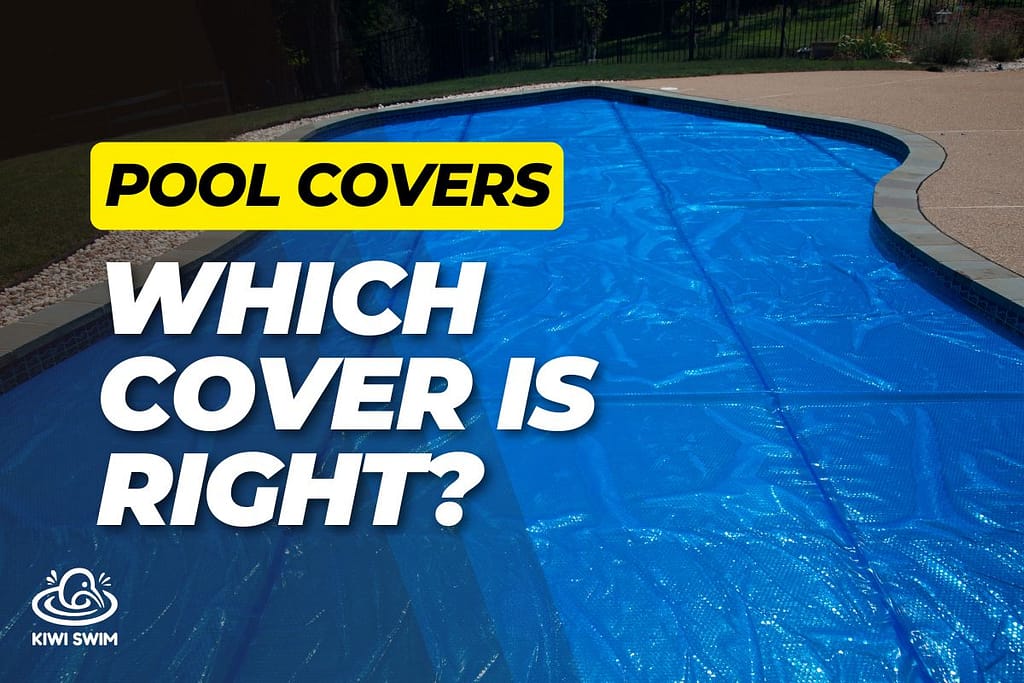
A solar pool cover, often called a pool blanket or bubble cover, is one of the most common choices for residential pools.
It floats directly on the water and is generally made from plastic with an air-bubble structure. The bubbles help reduce heat loss and, importantly, evaporation.
For a heated pool, this can make a noticeable difference because a large amount of heat can otherwise disappear through evaporation.
Why use a solar pool cover?
The main benefits are:
- Reduces evaporation
- Helps retain heat
- Can reduce the amount of heating required
- Helps keep some leaves and debris out
- Can reduce the amount of water you need to replace
- Usually costs considerably less than an automatic cover
- Relatively simple to use with a roller
A solar cover isn’t really intended to act as a physical safety barrier. Don’t treat a bubble cover as something that will support a person or prevent a child from entering the water.
What colour and thickness should you choose?
You’ll come across different thicknesses and colours when looking at solar covers.
In general, thicker material tends to be more durable, while the exact performance depends on the construction and quality of the cover rather than thickness alone.
I’d focus on:
- Material quality
- UV resistance
- Expected lifespan
- Warranty
- Correct fit
- Whether replacement material is readily available
- How easy it is to handle
A cheap cover that needs replacing frequently isn’t necessarily cheaper over the long term.
Thermal and pool blanket covers
Thermal covers are designed primarily to reduce heat loss. Some are similar in appearance and use to conventional bubble-style pool blankets, while other designs use different insulating materials.
They’re particularly useful if you’ve invested in pool heating.
The basic idea is simple: don’t spend money heating the pool only to let that heat escape when nobody is swimming.
A cover can also help reduce evaporation, which is useful because evaporation takes both water and heat with it.
If you’re heating your pool with a heat pump, gas heater or another heating system, I’d consider a good cover part of the overall heating system rather than an optional extra.
Automatic pool covers
Automatic pool covers are a more expensive option, but they solve one of the biggest problems with pool covers: actually using them.
Instead of manually lifting and folding a large cover, you operate the cover using a roller system.
Depending on the design, the roller can be installed at the end of the pool, incorporated into a bench or concealed within the pool structure.
Advantages of automatic covers
- Very convenient
- Easy to open and close
- Good heat retention
- Reduces evaporation
- Helps keep debris out
- Can make regular cover use much easier
- Some systems can be designed as safety barriers when properly specified and installed
The last point is important. Not every automatic pool cover is automatically a compliant safety barrier.
NZ building requirements around pool barriers are specific, and MBIE has published determinations concerning automatic pool covers. The compliance of a particular system depends on the circumstances and how the cover operates as a barrier.
If you’re considering an automatic cover partly for safety, don’t simply rely on a salesperson telling you that it’s a “safety cover”. Ask for documentation showing how the proposed system complies with the relevant NZ requirements.
Mesh pool covers
A mesh pool cover is generally more focused on keeping debris out and protecting the pool when it isn’t being used.
They’re particularly useful for pools surrounded by trees or properties where the pool isn’t used for long periods.
Mesh covers can allow rainwater through while catching leaves and larger debris. This can be useful during winter, although the exact performance depends on the cover design.
They’re also different from solar blankets. A mesh cover isn’t primarily designed to retain heat.
For a pool that gets heavy leaf fall, however, keeping hundreds of leaves out of the water can make winter maintenance much easier.
Winter pool covers
A winter pool cover makes sense if you aren’t using your pool much during the colder months.
New Zealand doesn’t have the same pool-closing culture as some colder countries, but there are plenty of situations where a cover is useful over winter.
For example, you might have:
- A pool that isn’t heated
- A holiday property
- A pool surrounded by deciduous trees
- A pool that gets very little use during winter
- A pool you’re deliberately keeping at lower maintenance levels
A winter cover should be selected based on the conditions it will experience, rather than simply buying the cheapest cover available.
Wind is particularly important. A loose cover can become a major nuisance if it isn’t properly secured.
Custom pool covers
If your pool is rectangular, most standard cover options are relatively straightforward.
Things become more interesting when you have:
- Curved edges
- Steps
- Built-in seating
- Raised walls
- Irregular shapes
- Water features
- Islands
- Unusual coping
- A narrow space around the pool
This is where custom pool covers can make much more sense.
A properly fitted cover should be easier to use and can provide better coverage than trying to make a standard rectangular cover work around an unusual pool shape.
Take accurate measurements, but for a more complicated pool I’d get the cover supplier to measure it themselves. A small measurement error can become a surprisingly annoying problem when you’re dealing with a large piece of material.
Do you need a pool cover roller?
If you’re buying a solar pool cover, I’d strongly consider a pool cover roller.
A large pool cover can be surprisingly awkward to handle manually. It gets wet, it’s bulky, and dragging it across paving can damage it.
A roller makes it much easier to:
- Remove the cover
- Put it back on
- Store it neatly
- Keep the cover off the ground
- Use the cover regularly
And that’s the important part.
The best pool cover is one you’ll actually use.
If two people have to wrestle with a large cover every time they want to swim, there’s a good chance it won’t get used consistently.
Pool covers and safety in New Zealand
This is the part I would pay particular attention to.
Under New Zealand’s Building Code requirements, residential pools capable of holding water to a depth of 400 mm or more generally require a physical barrier restricting access by unsupervised children under five. This applies to permanent, temporary and portable pools.
A normal solar pool cover does not replace your pool fence simply because it covers the water.
There are specific provisions for certain small heated pools, such as some spa pools, where a compliant safety cover can be used instead of a surrounding barrier. The pool must meet the relevant criteria, including a water surface area of 5 m² or less and walls at least 760 mm above the adjacent floor or ground, along with other requirements.
A compliant safety cover needs to be capable of restricting access by young children, withstand a foreseeable load and be readily returned to the closed position. It also needs appropriate safety signage.
So if safety is part of the reason you’re buying a cover, tell the supplier that from the beginning. Don’t buy an ordinary pool blanket and assume it will satisfy the same requirements.
If you’re unsure whether your proposed setup meets the Building Code, check with your local council or an appropriately qualified pool barrier professional.
Spa pool covers are different
Spa pool covers deserve a separate mention.
A good spa cover needs to do more than keep the water warm. If you’re relying on the cover as the safety barrier for a qualifying small heated pool, it needs to meet the specific requirements of F9/AS2.
MBIE states that a compliant safety cover must be able to restrict children’s access when closed, withstand a foreseeable load, be readily returned to the closed position and display signage identifying its child-safety features.
That means you shouldn’t assume that a lightweight insulated spa cover is automatically a compliant safety cover.
If you’re buying a new spa, I’d specifically ask the supplier whether the supplied cover is intended to comply with the relevant NZ Building Code requirements for use as a safety barrier.
How much does a pool cover cost?
There isn’t a useful single price for pool covers because the difference between a basic solar blanket and a fully integrated automatic cover is enormous.
Your cost will depend on things such as:
- Pool dimensions
- Pool shape
- Cover material
- Thickness and construction
- Manual versus automatic operation
- Roller type
- Above-ground versus concealed installation
- Custom fabrication
- Installation requirements
- Safety requirements
A basic solar cover is generally the lowest-cost approach, while a custom automatic system can become a significant investment.
I’d look at the total ownership cost, not just the initial price.
A more expensive cover that lasts longer and gets used every day can be better value than a cheap cover that’s difficult to handle and needs replacing frequently.
How long should a pool cover last?
There’s no universal lifespan.
UV exposure, chlorine, storage, handling, wind and general wear can all affect how long a cover lasts.
This is particularly relevant in New Zealand because pool covers spend a lot of time exposed to strong UV when they’re rolled up beside the pool.
A few things will help extend its life:
- Use a roller rather than dragging it across the ground
- Keep it clean
- Follow the manufacturer’s cleaning instructions
- Avoid unnecessary exposure to chemicals
- Store it correctly when it’s not being used
- Don’t leave it where sharp objects can damage it
- Check it regularly for deterioration
- Follow the manufacturer’s instructions for water chemistry and cover use
If the cover starts becoming brittle, cracked or difficult to handle, it’s worth considering replacement rather than continuing to use damaged material.
Common mistakes pool owners make
Buying a cover without thinking about how it will be used
A huge cover can be great at keeping heat in, but not if nobody wants to put it on.
Think about your normal swimming routine before buying.
Assuming every cover is a safety cover
This is probably the biggest mistake.
A solar blanket, pool blanket or ordinary winter cover shouldn’t be assumed to provide child protection.
If safety is the objective, buy a cover specifically designed and documented for that purpose.
Skipping the roller
For a larger pool, manually handling a cover can become frustrating very quickly.
A suitable roller can make the difference between using the cover every day and rarely using it.
Buying for the pool rather than the environment
Think about what’s around your pool.
A pool underneath large trees may benefit enormously from debris protection. A pool in full sun with a heat pump may benefit more from a quality thermal or solar cover.
Ignoring wind
Wind can turn a large loose cover into a major problem.
Consider how the cover will be secured and where it will be stored when removed.
Choosing purely on price
The cheapest cover isn’t necessarily the cheapest option over five years.
Consider durability, warranty, replacement cost, ease of use and whether you’ll actually use it.
When to call a professional
You can handle many basic pool-cover decisions yourself, particularly when you’re choosing a standard solar blanket and roller.
I’d get professional help when you’re dealing with:
- An unusual pool shape
- An automatic cover
- A concealed roller system
- Structural alterations
- Electrical work
- A cover intended to form part of a safety barrier
- A complicated retrofit
- Questions about Building Code compliance
If the cover is being installed as part of a new pool, it’s worth discussing it with the pool builder before construction is finished. Planning the roller or cover housing early can produce a much cleaner result than trying to retrofit everything later.
So, which pool cover should you choose?
For most pool owners, the decision becomes much easier once you work out what problem you’re actually trying to solve.
If your main goal is heat retention and reducing evaporation: a good solar or thermal pool cover is usually the logical starting point.
If your pool is heated and you use it regularly: spend more attention on heat retention and make sure the cover is easy to use.
If leaves and debris are your biggest problem: look at a suitable debris or mesh cover.
If convenience is important: consider an automatic cover or a good roller system.
If safety is the primary reason for buying the cover: make sure you’re looking specifically at a compliant safety cover rather than an ordinary pool blanket.
If your pool has an unusual shape: custom pool covers are worth considering.
And if you have a spa pool, treat its cover as a separate decision because the requirements can be quite different.
Frequently Asked Questions
Is a solar pool cover worth it?
For many NZ pool owners, yes. A solar pool cover can reduce evaporation and help retain heat, particularly when used on a heated pool. The biggest benefit comes from actually using it consistently.
Does a pool cover keep a pool warm?
Yes. A suitable pool cover reduces heat loss, particularly heat lost through evaporation. This can be especially useful for heated pools.
Can a pool cover replace a pool fence in NZ?
Not generally. Ordinary swimming pool covers and solar blankets should not be treated as pool barriers. There are specific provisions allowing compliant safety covers to act as barriers for certain small heated pools, such as qualifying spa pools.
Do I need a roller for a pool cover?
You don’t necessarily need one, but I’d strongly consider it for a large cover. A roller makes the cover much easier to remove and replace, which encourages you to use it regularly.
Are automatic pool covers safer?
They can provide significant safety benefits when properly designed and used, but you shouldn’t assume every automatic cover is a compliant pool barrier. If you’re relying on one for regulatory compliance, have the specific system assessed against the applicable NZ requirements.
What is the best pool cover for winter?
It depends on your priorities. If you’re mainly trying to keep leaves and debris out while the pool isn’t being used, a suitable winter or mesh cover can make sense. If you’re trying to retain heat in a heated pool, a thermal or solar-style cover may be more appropriate.
The bottom line
The best way to choose a pool cover is to start with the job you want it to do rather than choosing a cover simply because it looks like a good deal.
For most swimming pools, heat retention, evaporation, debris, ease of handling and cost will be the main considerations. A solar pool cover is a practical option for many heated pools, while automatic and custom pool covers can make sense when convenience, appearance or more specialised requirements justify the extra investment.
Just keep safety separate from the rest of the decision. A cover that keeps your pool warm isn’t necessarily a cover that keeps children safe. If you’re relying on a cover as a pool barrier, make sure the specific cover and pool setup comply with the relevant New Zealand requirements, rather than making assumptions based on the word “safety” in a product description.
For most pool owners, I’d prioritise a cover that does what you need, fits your pool properly and is easy enough to use that you’ll actually put it on. That’s usually where the real value of a pool cover comes from.