Pool installation is a major project, and the pool itself is only part of what you’re paying for. Excavation, drainage, foundations, plumbing, electrical work, filtration, heating, fencing, landscaping and ongoing maintenance can all affect the final result and the total cost.
If you’re thinking about installing a swimming pool at your home, it’s worth understanding the options before you start getting quotes. The right pool for one property can be completely wrong for another, particularly in New Zealand where site conditions, space, council requirements and climate all need to be considered.
This guide explains the main types of pools, how swimming pool installation works, what affects pool installation cost, the approvals you’ll need and the practical things I recommend considering before committing to a build.
What does pool installation involve?
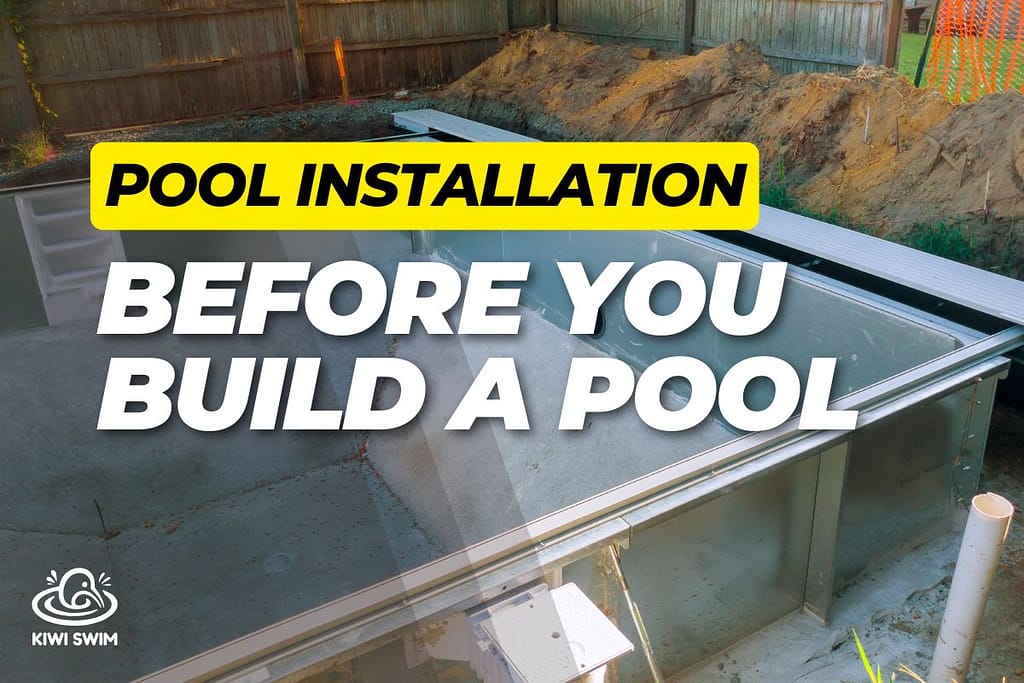
A pool installation involves considerably more than putting a pool shell or liner in the ground.
For a typical inground pool, the process can involve:
- Planning the pool’s location and design.
- Checking site access and ground conditions.
- Confirming building consent and other requirements.
- Excavating the site.
- Preparing the foundation or base.
- Installing the pool structure.
- Installing plumbing and circulation equipment.
- Installing filtration and chlorination equipment.
- Connecting electrical equipment where required.
- Backfilling and completing surrounding areas.
- Installing the required pool barrier.
- Filling, commissioning and balancing the pool water.
- Completing landscaping and other finishing work.
Exactly what is involved depends heavily on the type of pool and the property.
A fibreglass pool, for example, is manufactured before it arrives at your property, while a concrete pool is constructed on site. An above ground pool may require considerably less excavation but still needs a suitable base and compliant means of restricting access.
The cheapest-looking pool at the beginning isn’t necessarily the cheapest project once everything around it is included.
Choosing the right type of swimming pool
There are three broad options you’ll encounter when looking at residential swimming pool installation: concrete, fibreglass and above ground pools.
| Pool type | Main advantages | Main disadvantages | Often suited to |
|---|---|---|---|
| Concrete | Highly customisable shape, depth and size | More construction work and potentially higher cost | Custom designs and challenging layouts |
| Fibreglass | Fast installation and smooth manufactured surface | Limited to available shell shapes and sizes | Homeowners wanting a relatively straightforward inground pool |
| Above ground | Usually simpler and less disruptive | Less integrated appearance and design flexibility | Smaller budgets, temporary or simpler installations |
There are also vinyl-lined pools and other specialised systems. The important thing is not to choose purely on the advertised price of the pool.
Look at the complete installed project instead.
Concrete pools
Concrete gives you the greatest freedom when it comes to the shape, dimensions and depth of the pool.
This can be useful if you have an unusual section, a narrow backyard or a particular design in mind.
The downside is that you’re dealing with a construction project rather than simply installing a manufactured pool. Excavation, structural work, waterproofing, finishes and curing all form part of the process.
The finished surface also matters. Different interior finishes have different maintenance and refurbishment requirements.
Fibreglass pools
Fibreglass pools are manufactured as a single shell and transported to the property.
One of their major advantages is installation speed compared with a fully constructed concrete pool. The smooth manufactured surface is also relatively easy to clean.
The biggest limitation is design flexibility. You’re selecting from the manufacturer’s available shapes and sizes rather than designing every dimension yourself.
Transport and access can also become important. A pool shell has to physically get from the delivery vehicle to the excavation, so difficult access can complicate an otherwise straightforward installation.
Above ground pool installation
Above ground pools can be considerably simpler than a full inground construction project, but they shouldn’t automatically be treated as something that can simply be placed anywhere and filled.
The ground needs to be suitable and level, and the manufacturer’s installation requirements need to be followed.
Most importantly, New Zealand pool safety requirements still apply to many above ground and portable pools.
A pool capable of holding water to a depth of 400 mm or more generally requires a compliant barrier restricting access by unsupervised children under five. This can apply even to temporary or inflatable pools.
What to consider before installing a pool
Before choosing a swimming pool builder, look carefully at the property rather than starting with the pool catalogue.
Available space
Measure the actual area available, including the space required around the pool.
Don’t forget about:
- Pool fencing or other barriers
- Pool equipment
- Access around the pool
- Decking or paving
- Drainage
- Landscaping
- Outdoor furniture
- Access to the house
- Future maintenance access
A pool that technically fits into the backyard can still leave you with an awkward and cramped outdoor area.
Access for construction
This is one of the things homeowners can overlook.
Ask how excavation equipment, concrete trucks, pool shells and other materials will reach the proposed pool site.
A narrow side passage can make a huge difference to the cost and complexity of a project. In some situations, equipment may need to come over a house, through a neighbouring property or be brought in using specialised equipment.
Get this assessed before assuming that the installation will be straightforward.
Ground conditions
Your site may contain rock, unstable ground, buried services, groundwater or other complications.
Until the site is properly assessed, it’s difficult to know exactly what excavation and ground preparation will involve.
This is one reason comparing quotes purely on the headline price can be misleading.
Drainage
Think about where rainwater and other water will go.
New Zealand gets substantial rainfall in many areas, and poor drainage around a pool can create ongoing problems. Groundwater can also be an important consideration during construction.
Your builder should consider the site’s drainage requirements rather than treating them as an afterthought.
Pool installation cost in New Zealand
There isn’t a single useful price for pool installation because two apparently similar pools can have very different site and construction requirements.
Your total pool installation cost can include:
- Pool itself
- Excavation
- Removal of spoil
- Ground preparation
- Concrete or foundations
- Plumbing
- Pump
- Filter
- Chlorination system
- Electrical work
- Heating
- Pool cover
- Pool barrier
- Coping and paving
- Decking
- Drainage
- Landscaping
- Engineering where required
- Consent and inspection costs
When comparing pool contractors, make sure you understand exactly what is included in each quotation.
For example, one quote might include excavation and basic filtration while another includes landscaping, heating, fencing and electrical work. The second quote may look much more expensive while actually representing a similar or better overall value.
Don’t budget only for the pool
A useful way to think about the project is:
Pool + installation + compliance + surrounding area + equipment + finishing work
The surrounding area can become a surprisingly significant part of the project.
If you’re planning a tiled entertaining area, retaining walls, extensive landscaping and a heated pool, the pool itself may be only one component of the total project.
Pool equipment you need to think about
A swimming pool needs equipment to circulate, filter and sanitise the water.
A typical system can include:
- Circulation pump
- Filter
- Sanitising system
- Pool cleaner
- Skimmer
- Return fittings
- Valves and plumbing
- Control equipment
- Pool heating, if required
You should think about this equipment before construction rather than after the pool is finished.
The equipment needs somewhere to live, and you want reasonable access for maintenance.
A poorly located equipment area can turn simple maintenance jobs into a nuisance for years.
I recommend thinking about noise as well. Pumps and other equipment shouldn’t automatically be placed directly beside a bedroom or outdoor entertaining area without considering how and when they’ll operate.
Heating your new pool
Pool heating is worth considering during the design stage even if you don’t install a heater immediately.
Common options include heat pumps, solar heating and gas heating systems.
Your choice will depend on factors such as:
- Desired swimming season
- Pool size
- Climate
- Available space
- Electricity or gas availability
- Running costs
- Installation requirements
- Whether you’ll use a pool cover
A cover can be particularly useful with a heated pool because reducing heat loss can significantly affect how hard the heating system has to work.
It’s much easier to plan for heating, plumbing and electrical requirements during construction than to retrofit everything later.
Pool fencing and New Zealand requirements
Pool safety is one of the most important parts of pool installation in New Zealand.
Under the Building Act and Building Code requirements, residential pools that can be filled to a water depth of 400 mm or more generally need a physical barrier that restricts access by unsupervised children under five.
The barrier can be a fence, wall or another compliant arrangement, depending on the circumstances.
A pool barrier isn’t something to leave until after the pool has been installed. Its design and position can affect the entire layout of the pool area.
For example, a building may form part of the immediate pool area barrier, but doors and windows connecting the building to that area have specific requirements. Gates also have requirements around opening direction, child resistance and automatically returning to the closed position.
Building Performance also states that building consent is required for pool barriers, including barriers for temporary pools. A compliant safety cover can be an exception for certain small heated pools.
Because pool safety requirements are specific to the design, it’s sensible to discuss the proposed pool and barrier with your local council or appropriately qualified professional before construction.
What about inspections?
Residential pools are generally subject to mandatory inspections every three years. Owners can have these carried out by their territorial authority or an independently qualified pool inspector.
There are different rules for certain small heated pools where a compliant safety cover is being used as the barrier.
Do you need building consent for a pool?
Don’t assume that a pool is exempt from building consent simply because it’s small or prefabricated.
Building Performance states that building work involving residential pools requires building consent unless it falls within an applicable exemption. Even where the pool construction itself is exempt, the barrier generally still requires consent.
Other approvals can potentially be relevant depending on the property and work involved.
Before construction begins, check with your local council and make sure your pool builder understands the consent requirements for your particular project.
This is especially important if the installation involves significant excavation, retaining walls, drainage, structures or work close to boundaries.
How to choose a swimming pool builder
Choosing a swimming pool builder isn’t simply about finding the cheapest quote.
Ask prospective pool contractors:
- How long have they been installing pools?
- Who will actually carry out the work?
- What’s included in the quotation?
- Who handles the building consent?
- What ground preparation is included?
- What equipment is included?
- What warranty applies to the pool and equipment?
- How are unexpected ground conditions handled?
- Who installs the pool barrier?
- Who handles electrical work?
- What maintenance support is available after installation?
I’d also want to see examples of completed projects rather than relying solely on photographs supplied in advertising.
A good swimming pool builder should be able to explain the installation process clearly and identify potential problems before construction starts.
Be wary of a quote that looks dramatically cheaper than everyone else’s without a clear explanation of why.
Common pool installation mistakes
Choosing the pool before considering the site
It’s easy to fall in love with a particular pool shape and then discover that the property doesn’t suit it.
Start with the site, access, drainage and available space.
Forgetting equipment access
Pool equipment needs maintenance and eventually replacement.
Don’t bury the pump and filter in an inaccessible corner simply because it keeps them out of sight.
Leaving fencing until the end
The required barrier can affect where the pool, house access and landscaping can go.
Design it into the project from the beginning.
Assuming the quoted pool price is the final cost
Ask what isn’t included.
Excavation, spoil removal, fencing, electrical work, landscaping, heating and drainage can all affect the final bill.
Underestimating ongoing maintenance
Installing the pool is the beginning of ownership, not the end.
You’ll need to maintain water chemistry, clean the pool, look after the filter and pump, inspect equipment and keep the pool barrier compliant.
Think about maintenance when choosing the pool and equipment.
Choosing equipment purely on purchase price
Cheap equipment isn’t necessarily good value if it’s difficult to maintain, poorly sized or unsuitable for your pool.
The circulation system should be appropriately designed for the pool rather than selected simply because it’s the cheapest option.
DIY pool installation vs professional installation
Some types of above ground pool can be installed by a capable homeowner when the manufacturer’s requirements and applicable regulations are followed.
An inground pool is a different proposition.
Excavation, structural work, electrical systems, plumbing, drainage and regulatory compliance can all become involved. Electrical work and other specialist work should be carried out by appropriately qualified professionals.
I’d also be cautious about DIY work that could affect the structural integrity of an inground pool. A mistake buried beneath several cubic metres of water isn’t particularly easy to fix.
The sensible approach isn’t necessarily to have someone else do everything. It’s to understand which parts you can safely and competently handle yourself and which parts require specialist knowledge.
How long does pool installation take?
Installation time varies considerably.
A straightforward fibreglass installation can be much quicker than constructing a complex concrete pool, but the overall project isn’t determined solely by how long it takes to put the pool in the ground.
Consent, excavation, weather, site access, specialist trades, landscaping and availability of materials can all affect the schedule.
Ask your pool builder for a realistic project timeline and identify which parts depend on other contractors.
Think about the pool as a long-term project
A pool can add a lot to a home, but it’s worth thinking beyond the day it gets filled.
Consider how much you’ll use it, who will use it, how much time you’re prepared to spend maintaining it and what your future plans for the property are.
A smaller, well-designed pool that is easy to maintain can be a better choice than a much larger pool that dominates the backyard and costs considerably more to operate.
Likewise, spending money on good circulation, filtration, heating efficiency and a suitable cover can make a difference to the ownership experience for years.
Frequently Asked Questions
What is the best type of pool to install in New Zealand?
There isn’t one best pool for every property. Fibreglass can suit homeowners wanting a relatively fast installation and a manufactured finish, while concrete provides considerably more flexibility in shape and design. Above ground pools can suit simpler installations and tighter budgets.
How much does pool installation cost in NZ?
The total cost varies substantially depending on the pool type, site conditions, excavation, equipment, fencing, landscaping, heating and other work. Get detailed quotes that clearly state what is and isn’t included rather than comparing pool prices alone.
Do I need a fence around my pool in New Zealand?
A residential pool capable of holding water to a depth of 400 mm or more generally needs a compliant barrier restricting access by unsupervised children under five. The exact barrier arrangement depends on the pool and property.
Do swimming pools need building consent in NZ?
Pool construction may require building consent, although exemptions can apply in particular circumstances. Pool barriers generally require consent, including barriers for temporary pools. Check your specific project with your local council before starting work.
How often does a residential pool barrier need to be inspected?
Residential pools generally require mandatory inspection every three years. Small heated pools using a compliant safety cover as their barrier can be treated differently under the Building Code.
Is a fibreglass or concrete pool better?
Neither is automatically better. Fibreglass offers a manufactured shell and can make installation relatively straightforward, while concrete provides much greater freedom over the pool’s dimensions and design. Your property, budget and intended use should determine the choice.
Final thoughts on pool installation
A successful pool installation starts well before the first hole is dug.
Think about the property, access, drainage, pool type, equipment, heating, fencing, consent requirements and ongoing maintenance before choosing your pool. Most importantly, compare complete installed projects, not just the advertised price of the pool itself.
A good swimming pool builder should be able to explain what you’re buying, identify potential site problems and give you a realistic idea of what the finished project will involve.
If you take the time to get those decisions right at the planning stage, you’ll have a much better chance of ending up with a pool that not only looks good when it’s new, but remains practical and enjoyable to own for many years.