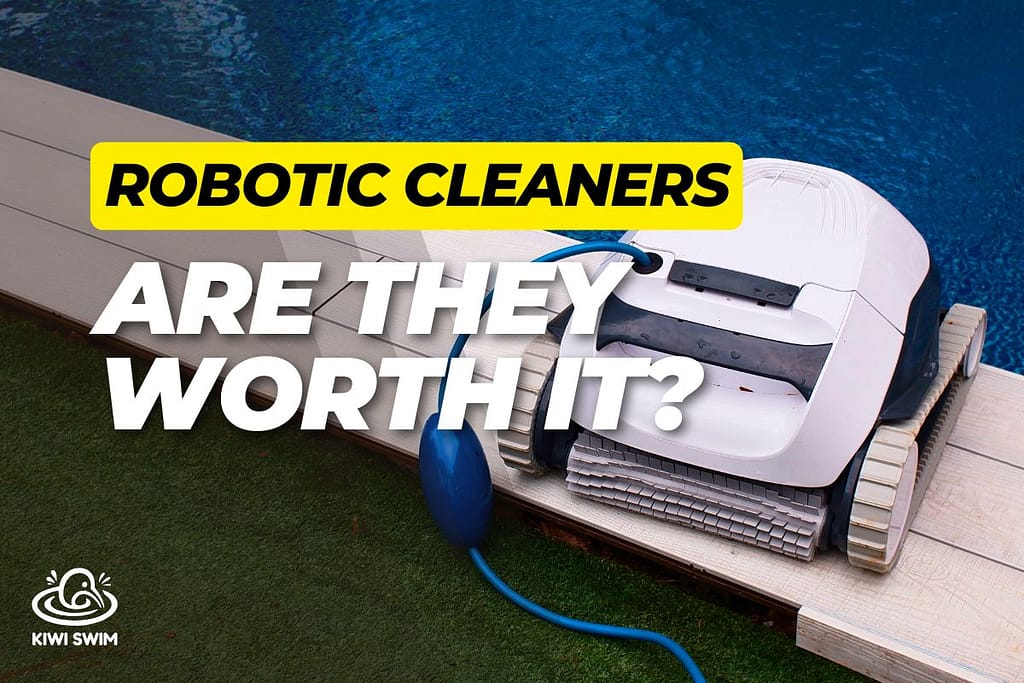
If you’re tired of manually vacuuming your pool or constantly dealing with a suction cleaner that gets stuck, you may be wondering: are robotic pool cleaners worth it?
For many New Zealand pool owners, my answer is yes, they can be well worth the investment. A good robotic pool cleaner can save you a lot of time, clean independently from your pool’s pump and filter system, and often provide better overall cleaning than cheaper automatic pool cleaners.
The catch is that robotic cleaners are usually more expensive upfront, and not every pool owner needs a top-of-the-range model.
The right choice depends on your pool, the type of debris you deal with, how often you use the pool, and how much manual cleaning you want to avoid.
In this guide, I’ll explain how pool robots work, what they actually do, their advantages and disadvantages, what they cost in New Zealand, and what to look for before buying one.
The short answer: Are robotic pool cleaners worth it?
Robotic pool cleaners are worth it if you want to reduce manual pool cleaning and are happy to pay more upfront for convenience.
Unlike a suction cleaner that relies on your pool pump, a robotic pool cleaner has its own motor, pump and filter. You place it in the pool, start the cleaning cycle and let it work independently.
A good robot can:
- Vacuum dirt and debris
- Brush the pool surface
- Collect debris in its own filter
- Clean the pool floor
- Climb and clean walls on suitable models
- Clean around the waterline on higher-spec models
For busy pool owners, that’s a significant improvement over manually vacuuming every week.
Robotic cleaners aren’t perfect, though. They still need their filter emptied and cleaned, they can struggle with some unusual pool shapes or obstacles, and cordless models need charging.
The biggest downside is the purchase price. In New Zealand, a decent robotic cleaner can cost considerably more than a basic suction cleaner. Current examples from Zodiac NZ range from around $1,200 for an entry-level cordless robotic cleaner to more than $3,000 for higher-end models.
How does a robotic pool cleaner work?
A robotic pool cleaner is essentially a self-contained automatic pool cleaner.
You lower it into the water, and its internal electric motor powers the cleaner’s movement and suction. Water and debris are drawn through the cleaner and collected in an internal filter basket or canister.
Unlike a traditional suction cleaner, it doesn’t rely on:
- Your pool pump
- Your pool filter
- The skimmer
- A dedicated suction line
This is one of the biggest advantages of robotic cleaners.
The basic cleaning process
Most pool robots work roughly like this:
- The cleaner moves around the pool using wheels or tracks.
- Brushes loosen dirt from the pool surface.
- An internal pump draws water and debris into the cleaner.
- Dirt is trapped inside the robot’s filter.
- Cleaned water is discharged back into the pool.
- The robot continues following its programmed cleaning pattern.
More advanced cleaners use sensors and navigation systems to improve pool coverage.
That doesn’t necessarily mean they will clean every centimetre of every pool perfectly, but better models are generally more efficient at covering the floor, walls and waterline.
What to know before buying a robotic pool cleaner
Before looking at brands or features, think about how the cleaner will actually be used in your pool.
Your pool size
Robotic cleaners are designed for different maximum pool sizes.
Don’t assume every robot will suit every pool. Check the manufacturer’s recommended pool dimensions before buying.
For example, some current Zodiac models are designed for pools up to 8 × 4 metres, while larger models are designed for significantly bigger pools.
Buying a cleaner that’s undersized for your pool can lead to poor cleaning coverage or longer cleaning times.
Your pool shape
Simple rectangular pools are generally easier for automatic cleaners to navigate.
Freeform pools, unusual shapes, steep slopes, ledges and awkward corners can be more challenging.
Most modern pool robots can handle a range of shapes, but it’s still worth checking the manufacturer’s recommendations for your particular pool.
Your pool surface
Check that the cleaner is suitable for your pool surface.
Common NZ pool surfaces include:
- Fibreglass
- Concrete
- Pebble finishes
- Tiles
- Vinyl liners
Brush design and traction can affect how well a cleaner performs on different surfaces.
The type of debris in your pool
This is something many people overlook.
A pool surrounded by trees will have very different cleaning needs from a pool in an open backyard.
Think about whether you’re mainly dealing with:
- Fine dust and sediment
- Leaves
- Pine needles
- Grass
- Sand
- Bugs
- Small twigs
- Algae and dirt on the pool surface
A cleaner with a larger filter capacity may be useful if your pool regularly fills with leaves.
Fine filtration is more useful when you’re dealing with smaller particles.
A robot can also reduce the amount of manual vacuuming required, but don’t expect it to solve every problem caused by heavy debris falling into the pool.
The biggest advantages of robotic pool cleaners
They save you time
This is the main reason most people buy one.
Manually vacuuming a pool can easily become another regular weekend job.
With a robot, you can drop it into the pool, start a cleaning cycle and get on with something else.
You still need to empty the filter and occasionally check the cleaner, but the actual vacuuming is largely automated.
They work independently from your pool system
Traditional suction cleaners rely on your pool’s circulation system.
That can create a few issues:
- The cleaner depends on adequate pump suction.
- It can reduce skimmer suction.
- It may affect circulation.
- It adds another load to the pool system.
A robotic pool cleaner has its own motor and filtration system, so it operates independently.
This is particularly useful if your existing suction cleaner struggles because of plumbing or pump performance.
They have their own filter
Instead of sending debris directly into your pool filter, a robotic cleaner collects it in its own filter.
This can reduce the amount of debris reaching your:
- Skimmer basket
- Pump basket
- Pool filter
Some robotic cleaners also use fine filtration to collect particles that might otherwise stay suspended in the water.
You still need to maintain your main pool filter, of course. A robot is a cleaning tool, not a replacement for your pool’s circulation and filtration system.
They can brush while they clean
Manual vacuuming and some automatic cleaners mainly remove loose debris.
Many robotic cleaners also use rotating brushes to help loosen dirt from the pool surface.
That can be useful for removing:
- Fine dirt
- Dust
- Light algae build-up
- General surface grime
Brushing is one reason a robot can often provide a more thorough clean than a basic suction cleaner.
Better models clean walls and waterlines
Not all pool robots clean the entire pool.
Some models only clean the floor, while others can climb walls and scrub the waterline.
This is worth checking carefully before buying.
If your main goal is simply keeping the floor clean, you may not need a premium model.
If you want the cleaner to handle the floor, walls and waterline, expect to pay more.
For example, current Zodiac robotic models vary significantly in their cleaning areas and features, so comparing models is important rather than assuming all robots offer the same coverage.
The disadvantages of robotic pool cleaners
The upfront cost is higher
This is the biggest drawback.
A basic suction cleaner can cost considerably less than a quality robotic cleaner.
Current NZ robotic cleaner pricing also varies widely. At the time of writing, examples on Zodiac NZ range from approximately $1,209 to $3,619 depending on the model and features.
That means you need to decide whether the convenience and cleaning performance justify the additional cost.
You still need to maintain them
A robot isn’t completely maintenance-free.
You’ll still need to:
- Empty the filter
- Rinse the filter regularly
- Check the brushes and tracks
- Remove leaves or debris
- Store it properly
- Charge cordless models
- Inspect cables on corded models
Fortunately, this maintenance is usually straightforward.
They can be heavy
Some robotic cleaners aren’t particularly light.
Lifting a water-filled robot out of the pool can be awkward, especially if you’re doing it regularly.
Some models have features designed to make removal easier, while others may need a hook or pool pole to retrieve them.
Weight is worth considering if you have back or mobility issues.
Corded models can have cable issues
A corded robotic pool cleaner needs to remain connected to its power supply.
The cable can occasionally become twisted or tangled, particularly if the robot isn’t designed with an effective swivel system.
That doesn’t mean corded robots are bad. In fact, they can offer long cleaning cycles without worrying about battery life.
It’s simply one of the trade-offs.
Cordless models need charging
A cordless robotic pool cleaner removes the hassle of a floating cable, but introduces another consideration: battery life.
Most cordless models have a limited cleaning time per charge.
For example, several current cordless Zodiac models advertise around two hours or more of operation, depending on the model.
That can be plenty for a normal residential pool, but you should check that the runtime is appropriate for your pool size and cleaning requirements.
Robotic pool cleaner vs suction cleaner
For most NZ pool owners, this is one of the most important comparisons.
| Cleaner type | Advantages | Disadvantages | Best suited to |
|---|---|---|---|
| Robotic pool cleaner | Independent operation, internal filtration, strong cleaning performance, brushes | Higher upfront cost, requires electrical charging or power supply | Owners wanting convenience and thorough cleaning |
| Suction cleaner | Usually cheaper, simple design, uses existing pool system | Relies on pump and suction, adds load to filtration system | Budget-conscious owners with suitable pool plumbing |
| Pressure cleaner | Can handle larger debris and operates separately from suction | More equipment and setup requirements | Pools with compatible pressure systems |
Robotic cleaners
The best choice if convenience and cleaning performance are your main priorities.
Suction cleaners
A good option if you want a simpler and cheaper automatic pool cleaner.
In my experience, suction cleaners can work very well when they’re properly matched to the pool and circulation system. They can be frustrating when the pump is undersized, the plumbing is restrictive or the cleaner constantly gets stuck.
Pressure cleaners
Pressure cleaners can also be effective, but they are a different type of system and may require additional equipment depending on the setup.
Corded vs cordless robotic pool cleaners
Cordless pool robots are becoming increasingly popular.
But cordless isn’t automatically better.
Corded robotic cleaners
Advantages:
- No battery charging
- Can run longer cleaning cycles
- Often well suited to larger pools
- Continuous power during operation
Disadvantages:
- Cable can be inconvenient
- The cable may twist or tangle
- You need a suitable power supply location
Cordless robotic cleaners
Advantages:
- No cable floating in the pool
- Easy to carry and deploy
- Convenient for regular cleaning
Disadvantages:
- Battery needs charging
- Runtime is limited
- Performance depends on battery condition
- Larger pools may require careful model selection
A cordless robotic pool cleaner is often a great choice for a typical residential pool, particularly if you value convenience.
However, I wouldn’t choose one purely because it’s cordless. Cleaning coverage, filtration, runtime, reliability and local support are more important.
What about brands such as Dolphin, Zodiac, Hayward, Aiper and WYBOT?
There are now plenty of robotic pool cleaner brands available.
The best robotic pool cleaners aren’t necessarily from one single manufacturer. The right choice depends on your pool and the support available in New Zealand.
Dolphin pool cleaner
Dolphin is one of the best-known names in robotic pool cleaning and has an established NZ presence.
Dolphin’s range includes different models aimed at different pool sizes and cleaning requirements. The brand highlights the independent filtration and energy-saving potential of robotic cleaning.
When comparing a Dolphin pool cleaner, look at:
- Pool size compatibility
- Floor-only or wall cleaning
- Filter type
- Cable or cordless design
- Weight
- Warranty and local servicing
Zodiac pool cleaner
Zodiac has a broad range of robotic cleaners available in New Zealand, including both corded and cordless models.
The range includes entry-level models through to higher-spec robots with app connectivity, multiple cleaning modes and waterline cleaning.
A Zodiac pool cleaner can be a good option if you want access to an established local range and support network.
Hayward pool cleaner
Hayward also produces pool cleaning equipment, including robotic cleaners in international markets.
If you’re considering a Hayward pool cleaner in New Zealand, check the exact model’s NZ availability, warranty and servicing options before buying. This is particularly important with pool equipment because access to local parts and support can matter just as much as the features on the box.
Aiper pool cleaner
Aiper is well known for cordless robotic pool cleaners and is particularly popular in the growing cordless market.
Before buying an Aiper pool cleaner, check exactly what areas it cleans. Some models are better suited to floors, while more advanced models offer wall and waterline cleaning.
Also check local warranty and servicing arrangements rather than relying entirely on overseas reviews.
WYBOT pool cleaner
WYBOT also has a growing range of cordless pool robots available to NZ buyers.
Current models advertised through WYBOT NZ include cleaners designed for both above-ground and in-ground pools, with features such as wall climbing, waterline cleaning and app connectivity varying by model.
As with any newer brand, I recommend looking closely at:
- Local warranty support
- Spare parts availability
- Battery warranty
- NZ servicing options
- The suitability of the model for your pool
Are robotic cleaners suitable for above-ground pools?
Yes, but you need to buy a model specifically suitable for an above-ground pool.
An above ground pool cleaner doesn’t necessarily need all the features required for a large in-ground pool.
Depending on the pool, you may only need:
- Floor cleaning
- A compact design
- A suitable cleaning cycle
- Adequate filtration
- Compatibility with the pool surface
Wall-climbing capability may or may not be necessary depending on the design of your pool.
Don’t assume an expensive in-ground pool robot is automatically the best choice for an above-ground pool.
How much maintenance does a pool robot need?
Robotic cleaners are relatively easy to maintain, but they still need regular attention.
After each cleaning cycle
I recommend:
- Removing the robot from the pool.
- Emptying the debris filter.
- Rinsing the filter with clean water.
- Checking for trapped leaves or debris.
- Allowing the cleaner to dry as recommended by the manufacturer.
Regularly inspect
Check the:
- Brushes
- Tracks or wheels
- Filter basket
- Cable, if fitted
- Charging connections on cordless models
A cleaner that isn’t moving properly or isn’t picking up debris may simply have a blocked filter or worn components.
Following the manufacturer’s cleaning and storage instructions is important, particularly for battery-powered cleaners.
Common mistakes pool owners make with robotic cleaners
Buying based on price alone
A cheap robot that doesn’t suit your pool isn’t a bargain.
Make sure the cleaner is suitable for your pool size, shape and surface.
Assuming every robot cleans walls
Some cleaners only clean the floor.
Always check the actual cleaning coverage before buying.
Leaving the filter full of debris
A clogged filter reduces cleaning performance.
If your pool gets lots of leaves, you may need to empty the robot more frequently.
Expecting the robot to replace normal pool maintenance
A robotic cleaner doesn’t replace:
- Water testing
- Chemical balancing
- Pool circulation
- Filter maintenance
- Skimming heavy surface debris
- Occasional manual brushing
Your robot is one part of your pool maintenance routine.
Choosing a cordless model without checking runtime
A cordless robot needs enough battery capacity to clean your pool properly.
A short cleaning cycle may be frustrating in a larger or heavily soiled pool.
Ignoring local support
This is particularly important with expensive pool equipment.
Before buying, find out:
- Who handles warranty claims
- Whether replacement parts are available
- Whether there is local servicing
- How long the warranty lasts
A robot can look great online, but support matters if something goes wrong.
What features are worth paying extra for?
Not every feature is essential.
I would prioritise the following.
Wall cleaning
Worth paying for if you don’t want to regularly brush or manually clean the pool walls.
Waterline cleaning
Useful for pools that develop visible dirt and grime around the waterline.
Fine filtration
A good option if your pool regularly gets fine dirt or sediment.
Larger debris capacity
Helpful if your pool is surrounded by trees.
Easy filter access
Top-access filters are generally much more convenient than designs that require you to turn the cleaner upside down.
Good local support
In my view, this is one of the most valuable features, even though it isn’t something printed prominently on the product specifications.
Smart controls
App control, scheduling and multiple cleaning modes can be convenient, but I wouldn’t pay a large premium for them unless you’ll actually use them.
A cleaner that reliably cleans your pool is more valuable than an app full of features you never open.
So, are expensive robotic pool cleaners worth it?
Not always.
A more expensive robot is usually worth it when the additional features genuinely solve a problem for you.
For example, paying extra may make sense if you need:
- Waterline cleaning
- Better fine filtration
- Longer runtime
- Larger pool coverage
- Improved navigation
- Cordless operation
- App control
- Easier removal from the pool
But if you have a small, simple pool and only want the floor cleaned, a premium $3,000-plus robot may be unnecessary.
The best value robotic pool cleaner is the one that does what you actually need without paying for features you won’t use.
When should you consider professional help?
You shouldn’t normally need a professional to set up and operate a robotic pool cleaner.
However, professional advice can be useful if:
- You’re unsure which cleaner suits your pool
- Your pool has an unusual shape
- The cleaner is repeatedly getting stuck
- You have electrical concerns
- Your existing pool equipment has circulation problems
- You’re deciding between several expensive models
For electrical safety, always follow the manufacturer’s instructions for the cleaner’s power supply, charging equipment and operation.
Don’t modify electrical components or use damaged cables or charging equipment.
Frequently Asked Questions
Are robotic pool cleaners better than suction cleaners?
Robotic cleaners generally offer more independent operation and often better cleaning coverage, but they cost more upfront. A good suction cleaner can still be an excellent choice for the right pool.
Do robotic pool cleaners use a lot of electricity?
Robotic cleaners use electricity, but they don’t rely on running your pool pump to operate. Actual energy use depends on the model and cleaning time. Check the manufacturer’s specifications when comparing cleaners.
Can you leave a robotic pool cleaner in the pool all the time?
It’s generally better to follow the manufacturer’s recommendations. Many cleaners are designed to be removed after cleaning, particularly to make filter maintenance easier and reduce unnecessary exposure to pool chemicals and the outdoor environment.
How long do robotic pool cleaners last?
Lifespan depends on the model, how often it’s used, how well it’s maintained and the availability of replacement parts. A higher purchase price doesn’t guarantee a longer lifespan, so warranty and local support should be part of your decision.
Are cordless robotic pool cleaners worth it?
They can be very convenient because there is no cable to manage. The trade-off is limited battery runtime and the need to recharge. They’re often an excellent choice for typical residential pools if the runtime and cleaning coverage suit your needs.
Will a robotic cleaner clean algae from my pool?
A robotic cleaner can help brush and remove some loose algae and debris, but it won’t fix the underlying cause of an algae problem. If your pool is green or has an algae outbreak, you’ll still need to correct the water chemistry and sanitisation.
Are robotic pool cleaners worth it for NZ pool owners?
For many pool owners, robotic pool cleaners are worth it because they save time and make regular pool cleaning much easier.
They’re particularly useful if you’re tired of manual vacuuming or dealing with a suction cleaner that depends heavily on your pool’s pump and plumbing.
The main thing is to choose the right cleaner for your pool rather than simply buying the most expensive model or the one with the longest feature list.
Check your:
- Pool size
- Pool shape
- Pool surface
- Typical debris
- Required cleaning coverage
- Preference for corded or cordless operation
- Budget
- Warranty and NZ support
A good robotic pool cleaner won’t eliminate every pool maintenance job, but it can take one of the most time-consuming jobs off your hands. For a lot of Kiwi pool owners, that’s exactly what makes the investment worthwhile.