If you own a swimming pool, pool water testing is one of the simplest things you can do to prevent cloudy water, algae, scaling, corrosion and uncomfortable swimming conditions.
The good news is that you don’t need to be a pool chemist to test your water properly. For most NZ residential pools, a basic testing routine using a decent test kit or testing strips can tell you whether your chlorine and pH are where they need to be. More detailed testing can then be used to keep an eye on alkalinity, calcium hardness, cyanuric acid and other factors.
New Zealand’s pool water quality guidance provides recommended ranges and testing frequencies for domestic pools, although the exact targets you should use can depend on your pool type, sanitiser and equipment.
Here’s what you need to know.
Why is pool water testing important?
Pool water can look perfectly clear while its chemistry is out of balance.
That’s why relying on appearance alone isn’t enough. A pool can be sparkling clear while having too little chlorine, an unsuitable pH or excessive stabiliser. Conversely, a pool that looks slightly cloudy may have a chemical imbalance, filtration problem or contamination issue that needs investigating.
Regular testing helps you identify problems before they become expensive or difficult to correct.
It allows you to monitor things such as:
- Free chlorine
- pH
- Total alkalinity
- Calcium hardness
- Cyanuric acid, also called stabiliser
- Total chlorine and combined chlorine
- Salt levels in saltwater pools
- Total dissolved solids in some circumstances
You don’t necessarily need to measure every one of these every time you test.
For most pool owners, chlorine and pH are the two measurements you should pay the most attention to on a routine basis.
What should you test in your pool?
Different measurements tell you different things about what’s happening in your water.
| Test | What it tells you | How often to monitor |
|---|---|---|
| Free chlorine | How much active chlorine is available to sanitise the pool | Regularly |
| pH | How acidic or alkaline the water is | Regularly |
| Total alkalinity | How resistant the pH is to changing | Periodically |
| Calcium hardness | Whether the water may be too aggressive or prone to scaling | Periodically |
| Cyanuric acid | How much chlorine stabiliser is present | Periodically |
| Total chlorine | Free chlorine plus combined chlorine | When needed |
| Combined chlorine | Chlorine that has reacted with contaminants | When investigating water quality |
| Salt | Salt concentration for salt chlorinators | As required by the chlorinator |
| TDS | Overall concentration of dissolved substances | Occasionally, depending on the pool |
You don’t need to buy a complicated testing machine just to keep an ordinary residential pool under control.
A good test kit combined with sensible testing habits is enough for many homeowners.
What are the ideal pool water levels?
There isn’t one universal number that applies to every pool and every sanitising system.
NZS 5826 provides water-quality criteria for swimming pools, including pH, alkalinity, calcium hardness, free available chlorine and cyanuric acid. For swimming pools, it gives a pH range of 7.2 to 8.0, with 7.4 to 7.6 listed as the most desirable range.
For a chlorine-only swimming pool, the standard lists free available chlorine between 1.5 and 7.0 mg/L, with 2.5 to 5.0 mg/L as the most desirable range. Where chlorine is used alongside another treatment method, different chlorine ranges apply.
Your chlorinator or chemical manufacturer’s instructions may specify a narrower operating target, so it’s sensible to follow those instructions rather than treating a single number as appropriate for every pool.
pH
pH affects both swimmer comfort and how effectively chlorine works.
When pH gets too high, chlorine becomes less effective and you can encounter problems such as cloudy water and scale formation.
When pH gets too low, the water can become corrosive and may contribute to eye irritation, damage to some surfaces and corrosion of metal components.
For many residential pools, keeping pH around 7.4 to 7.6 is a sensible target.
Free chlorine
Free chlorine is the chlorine that remains available to sanitise the water.
This is more useful to monitor than simply knowing how much chlorine you’ve added. Sunlight, bathers, leaves, dirt and other contaminants all consume chlorine.
If free chlorine is too low, the pool can become vulnerable to algae and other water-quality problems.
Total and combined chlorine
Total chlorine includes free chlorine plus combined chlorine.
Combined chlorine is essentially chlorine that has already reacted with contaminants. A high combined chlorine reading can indicate that the pool has accumulated chloramines, which can contribute to a strong chlorinous smell and swimmer irritation.
This is one reason a pool that smells strongly of chlorine isn’t necessarily a pool with “too much chlorine”. Sometimes the problem is actually inadequate free chlorine relative to the contaminant load.
Total alkalinity
Alkalinity helps resist changes in pH.
If alkalinity is too low, pH can become difficult to keep stable. If it’s too high, pH can tend to rise and the water may have an increased tendency to form scale.
NZS 5826 gives different alkalinity ranges depending on the type of chlorination used, so don’t blindly follow a single alkalinity number without considering your pool system.
Calcium hardness
Calcium hardness measures the amount of dissolved calcium in the water.
Too little calcium can contribute to aggressive water that attacks certain surfaces and equipment. Too much can contribute to scaling and cloudy water.
This is particularly worth monitoring in pools with concrete, plaster or other mineral-based surfaces, although it can matter for other pool types as well.
Cyanuric acid
Cyanuric acid, commonly called stabiliser, helps protect chlorine from being destroyed by sunlight.
It’s particularly important for outdoor pools in New Zealand, where UV exposure can consume unstabilised chlorine quickly.
But stabiliser isn’t something you should keep adding just because chlorine is disappearing quickly. It accumulates in the water, so excessive levels can become a problem.
Test it periodically, particularly if you use stabilised chlorine products or have a salt chlorinator.
How often should you test your pool water?
Your testing routine should reflect how heavily the pool is used and what type of system you have.
NZS 5826 lists minimum testing frequencies for domestic pools, including twice-weekly pH testing and regular testing of alkalinity, calcium hardness and cyanuric acid. It also calls for free available chlorine to be checked prior to use for domestic swimming pools.
In practice, I recommend testing more often when conditions change.
For example, test your pool more frequently when:
- The weather has been hot and sunny
- You’ve had a lot of people swimming
- Heavy rain has entered the pool
- You’ve added a significant amount of fresh water
- The pool has developed algae
- The water has become cloudy
- You’ve recently adjusted the chemistry
- The chlorinator isn’t keeping up
- You’re trying to recover a problem pool
A quick chlorine and pH check is far easier than trying to recover a green pool several days later.
What is the best way to test pool water?
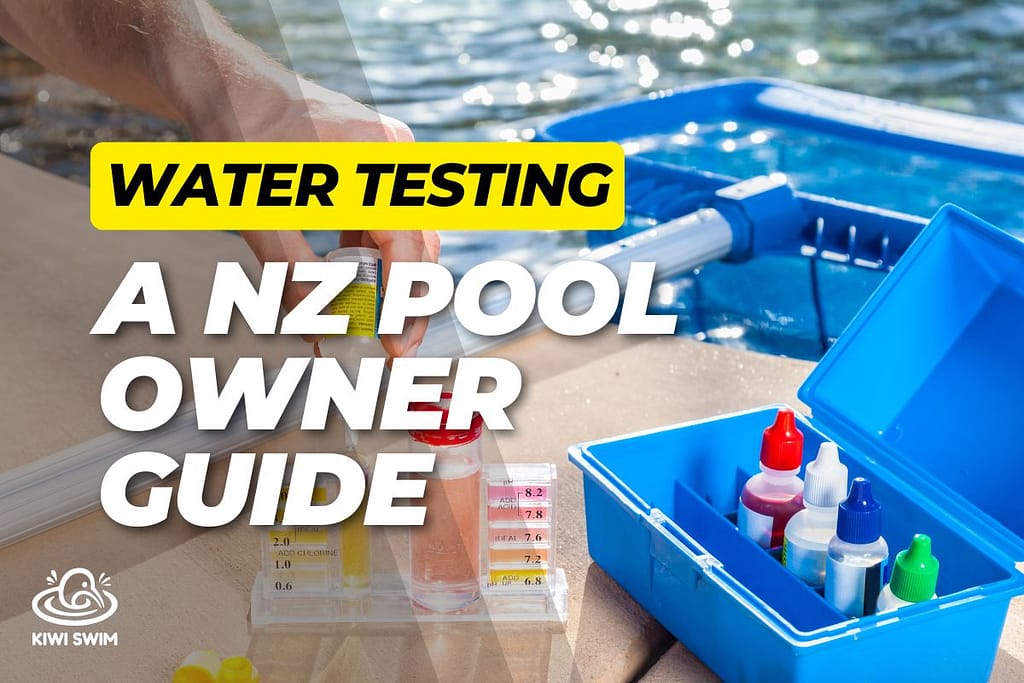
There are three main approaches available to most NZ pool owners:
- Testing strips
- Liquid or tablet testing kits
- Digital testing equipment or professional testing
Each has a place.
Testing strips
Testing strips are probably the easiest option for routine checks.
You dip the strip into the pool, remove it and compare the colour changes against the manufacturer’s chart. Some products test several parameters at once.
For example, 7-in-1 pool testing strips available in NZ can measure free chlorine, total chlorine, pH, alkalinity, hardness and cyanuric acid.
Advantages:
- Quick
- Easy to use
- Inexpensive
- Convenient
- Good for frequent checks
- No bottles of liquid reagents to handle
Disadvantages:
- Colour matching can be subjective
- Poor storage can affect the strips
- Different brands have different accuracy and ranges
- They aren’t always ideal when you need to diagnose a difficult water-quality problem
Keep the container sealed and follow the manufacturer’s instructions. Don’t leave the lid sitting open while you’re working around the pool.
Liquid and tablet test kits
A proper testing kit gives you a more controlled way of measuring important parameters.
Many pool kits use DPD reagents for chlorine testing. Some use tablets, while others use liquid reagents.
The water changes colour after the reagent is added, and you compare it against a reference scale.
These kits can be more useful than strips when you’re trying to make a chemical adjustment accurately.
NZ suppliers sell basic kits that measure pH and chlorine, as well as more comprehensive kits covering parameters such as alkalinity and calcium hardness.
For a pool owner who likes to manage their own water chemistry, I’d generally prefer a decent test kit over relying exclusively on strips.
Digital testing equipment
Digital testers and photometers take the colour interpretation out of the equation.
A photometer measures the colour produced by a reagent and gives you a numerical result.
Professional-grade units can test several parameters, including free chlorine, total chlorine, pH, alkalinity, calcium hardness and cyanuric acid. Some models are waterproof and Bluetooth-enabled.
A sophisticated testing machine can make sense for a pool professional looking after multiple pools, but it can be difficult to justify the expense for someone maintaining one residential pool.
Testing kit vs testing strips vs digital testing
| Method | Best for | Advantages | Disadvantages |
| Testing strips | Quick routine checks | Fast, cheap and simple | Colour matching can be less precise |
| Tablet/liquid kit | Regular home maintenance | More detailed and controlled testing | Takes longer and requires reagents |
| Digital tester | Detailed testing and professionals | Numerical results and less subjective colour matching | Much more expensive |
| Shop testing | Troubleshooting and detailed analysis | Useful second opinion | Requires taking a sample to the shop |
For most homeowners, testing strips plus a decent test kit is a very practical combination.
You can use strips for quick checks and the more detailed kit when something doesn’t look right.
How to take a good pool water sample
A poor sample can give you a misleading result, so don’t simply scoop water from the very top of the pool.
A good general approach is:
- Take the sample away from return jets and chemical dosing points.
- Collect water from below the surface rather than directly from the top.
- Use a clean container or the container supplied with your test kit.
- Don’t contaminate the sample with chemicals, sunscreen or dirty hands.
- Test the sample promptly.
- Follow the exact timing and sampling instructions supplied with your test product.
If you’re taking a sample to a shop for water testing near me, ask the store what type of container and sample volume they require.
Some retailers provide their own bottles and testing systems. Bunnings NZ, for example, offers in-store pool water testing at its pool chemical kiosks. The service uses a water sample and combines the test results with information about the pool, including its volume, surface and sanitising system.
Should you use a pool water testing service?
You don’t necessarily need professional testing for every routine check.
However, a water testing service can be extremely useful when you’re dealing with a problem that you can’t resolve yourself.
I’d consider getting a detailed test when:
- Your pool keeps going green
- The water remains cloudy despite correct filtration
- Your chlorine disappears unusually quickly
- You have persistent scaling
- The pH keeps moving dramatically
- You’re unsure about calcium hardness or stabiliser
- You’ve recently filled the pool from an unusual water source
- You’re opening a neglected pool
- You’re trying to recover from a major chemical imbalance
A second set of test results can also help identify whether your home testing method is giving you sensible readings.
What about a pool testing app?
Some modern testing products work alongside a testing app.
An app can be useful for recording readings, tracking changes and, depending on the system, calculating chemical additions.
Some testing strips sold in NZ are compatible with apps that use the strip result as part of the testing process.
The important thing is not to confuse convenience with accuracy.
An app can help you interpret and record a test, but it can’t compensate for a poorly collected sample, expired testing materials or incorrect testing technique.
I see apps as a useful addition to a testing routine, rather than a replacement for understanding what you’re actually measuring.
Common pool water testing mistakes
Testing only when the water looks bad
By the time a pool turns green or cloudy, the chemistry may have been wrong for days.
Regular testing is preventative maintenance.
Adding chemicals without testing first
This is one of the easiest ways to chase your tail.
If you don’t know the starting level, you’re effectively guessing how much chemical the pool needs.
Test first, make the appropriate adjustment, then test again when necessary.
Trusting one test result blindly
If a result looks completely out of character, test again.
Check that the kit hasn’t expired, the strips have been stored correctly and you’ve followed the instructions precisely.
If the result still doesn’t make sense, have the water professionally tested.
Testing immediately after adding chemicals
Give chemicals appropriate time to disperse according to the product instructions before judging the final water chemistry.
Otherwise you may be testing a concentrated pocket of chemical rather than representative pool water.
Ignoring stabiliser
Pool owners sometimes keep adding chlorine because the chlorine level won’t stay up, without checking whether stabiliser and the rest of the water chemistry are appropriate.
If you’re continually having chlorine problems, look at the whole system rather than simply adding more chlorine.
Treating a test strip as laboratory equipment
Testing strips are useful, but they aren’t magic.
They’re excellent for quick monitoring, but if you’re making a significant chemical correction or investigating a persistent problem, a better testing method can be worthwhile.
Can you test pool water yourself?
Yes. Routine pool water testing is something most reasonably capable pool owners can do themselves.
You don’t need professional training to dip a testing strip or use a basic pool test kit.
The important part is learning what the results mean and following the manufacturer’s instructions.
Where things become more complicated is when you’re dealing with a major water-quality problem, unusual contamination, specialised equipment or chemical treatment outside your normal maintenance routine.
If you’re unsure about a chemical treatment, particularly when multiple products are involved, follow the product labels and ask a pool professional rather than experimenting.
Never mix pool chemicals together unless the manufacturer specifically provides instructions for doing so. Store chemicals securely and away from children, ignition sources and incompatible products. NZ councils also advise following product instructions carefully and storing pool chemicals safely.
What should you do if your test results are wrong?
First, don’t immediately start pouring chemicals into the pool.
Repeat the test.
Check:
- The test kit or strips are within their usable date
- The strips have been stored correctly
- Your sample was taken properly
- You followed the specified testing time
- The colour was read under suitable lighting
- You used the correct reagent
- The testing equipment is clean
If the second result still seems unusual, get the water tested using another method.
This is particularly important if the result suggests a major imbalance but the pool looks and behaves completely normally.
When to call a professional
You can handle routine testing and many basic water adjustments yourself.
Professional help becomes sensible when the problem doesn’t respond to normal maintenance or you’re unsure what’s causing it.
Consider getting help if:
- Your pool repeatedly turns green
- You can’t maintain a sensible chlorine level
- The water remains cloudy
- You’re dealing with significant scaling or staining
- Your testing results conflict with professional results
- You need to diagnose an equipment problem
- You’re unsure how different chemicals interact with your particular system
- The pool has been contaminated by faecal matter or another significant source
Domestic pools can harbour pathogens, and NZ public health guidance specifically addresses contamination risks such as Cryptosporidium and Giardia. If you suspect significant contamination, keep people out of the pool and seek appropriate advice rather than trying to guess your way through the treatment.
Frequently Asked Questions
How often should I test my pool water?
For a domestic pool, regular testing is important. NZS 5826 specifies twice-weekly testing for pH and testing free available chlorine before use, with less frequent testing of parameters such as alkalinity, calcium hardness and cyanuric acid.
In practice, test more frequently during hot weather, heavy pool use, after heavy rain or whenever you’re trying to correct a water-quality problem.
Are pool testing strips accurate?
Good-quality pool testing strips can be very useful for routine monitoring, but colour matching is inherently less precise than some reagent-based or digital methods.
They’re best viewed as a convenient way to monitor your pool rather than the only testing method you’ll ever need.
What is the most important pool water test?
For most chlorine-treated residential pools, free chlorine and pH are the most important routine measurements.
Other tests, particularly alkalinity, calcium hardness and cyanuric acid, are still important because they affect how stable and manageable the pool water is.
Where can I get pool water testing near me?
Many NZ pool retailers offer water testing services. Some hardware stores also provide testing. Bunnings NZ currently offers in-store pool water testing at its pool chemical kiosks, using a water sample and information about your pool.
Do saltwater pools still need water testing?
Yes.
A salt chlorinator makes chlorine from salt, but it doesn’t eliminate the need to monitor water chemistry. You still need to keep an eye on chlorine, pH and other relevant parameters, while also maintaining the salt concentration recommended for your particular chlorinator.
Do I need a digital testing machine for my pool?
Probably not if you’re looking after one normal residential pool.
A decent testing kit and/or quality testing strips are sufficient for routine maintenance for most owners. Digital photometers are more useful when you want highly repeatable testing or you’re managing multiple pools.
The bottom line on pool water testing
Good pool water testing isn’t about obsessing over every number in the water every day. It’s about knowing what’s happening before a small imbalance becomes a major pool problem.
For most NZ pool owners, I’d keep things simple:
- Check chlorine and pH regularly.
- Use testing strips for convenient routine monitoring if you like them.
- Keep a decent tablet or liquid test kit available for more detailed checks.
- Periodically test alkalinity, calcium hardness and cyanuric acid.
- Test more often after heavy use, hot weather, rain or when something changes.
- Don’t add significant quantities of chemicals based purely on guesswork.
- Get a professional water test when your own results don’t make sense or you can’t resolve a persistent problem.
Once you get into the habit of testing your water regularly, pool maintenance becomes much more predictable. Instead of waiting for cloudy water, algae or scale to tell you something is wrong, your test results give you an early warning and let you deal with the problem while it’s still manageable.