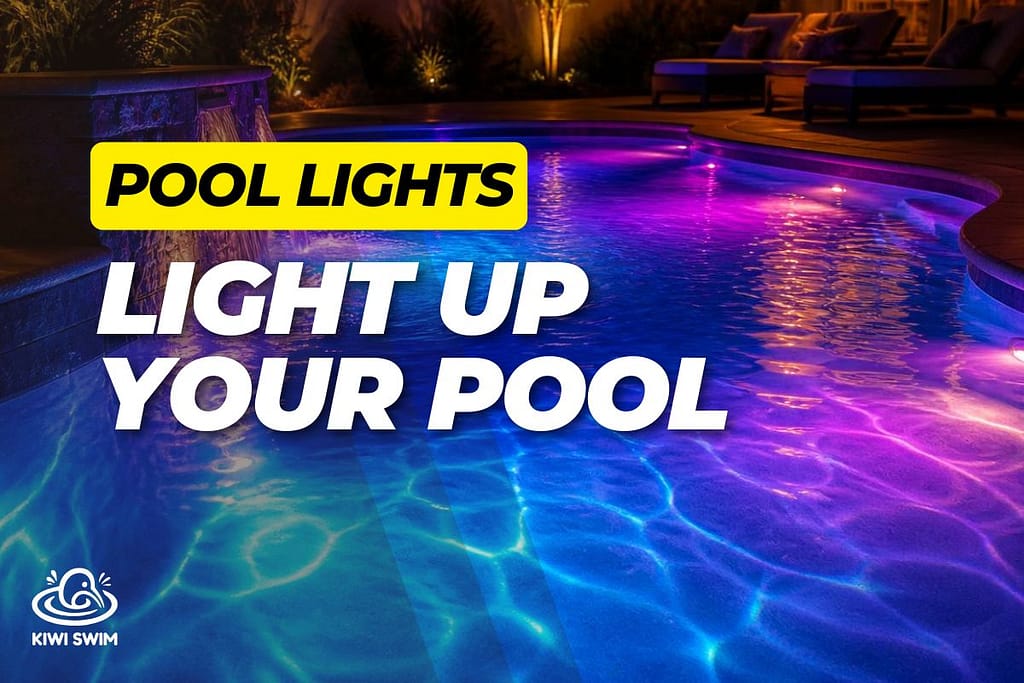
A good pool light can completely change how your swimming pool looks and feels after dark. It can also make the pool area easier to use at night, particularly around steps, entry points and other areas where visibility matters.
There are plenty of options available, from permanent underwater LED lights to floating pool lights, magnetic lights and simple above-ground pool lighting. The right choice depends on your pool type, how the light will be installed, your existing electrical system and whether you’re looking for practical illumination or more of a decorative effect.
If you’re considering new swimming pool lights or replacing an old light, here’s what you need to know before buying anything.
What is a pool light?
A pool light is a light designed to illuminate a swimming pool, usually from underwater or around the pool’s perimeter.
Traditional inground pool lights are installed into a niche or fitting built into the pool wall. Modern LED pool lights can be much more compact and may use existing fittings, surface mounting or magnetic attachment systems.
There are also completely portable options. Floating pool lights, solar pool lights and some wireless or battery-powered lights can be placed in or around the pool without permanently modifying the pool structure.
Pool lighting can serve several purposes:
- Improving visibility when swimming at night
- Making steps and entry points easier to see
- Creating a more attractive outdoor area
- Highlighting pool features and landscaping
- Providing decorative lighting for entertaining
- Making an older pool look more modern
It’s worth remembering that pool lighting isn’t a substitute for proper supervision or other pool safety measures. NZ residential pools capable of holding 400 mm or more of water generally require a physical barrier to restrict access by young children.
What to know before choosing swimming pool lights
Before buying a new light, I recommend checking what you already have rather than simply choosing the light that looks best online.
The existing installation can have a big influence on what will work.
Check:
- What type of pool do you have?
Concrete, fibreglass, vinyl-lined and above-ground pools can have quite different lighting arrangements. - Is there already a pool light?
If you’re replacing an existing light, keeping the existing niche or fitting may make the job much simpler. - What voltage and power supply does the existing light use?
Don’t assume that two lights that look similar are electrically interchangeable. - How is the light controlled?
Some systems use a normal switch, while others have dedicated controllers or colour-changing controls. - Where is the transformer or power supply located?
This is particularly important when replacing an older system. - Do you want functional lighting or decorative lighting?
A small floating light can look great, but it isn’t necessarily going to illuminate a whole pool. - Are you near the coast?
Salt air and corrosion can be hard on outdoor electrical equipment and fittings, so material quality and installation matter.
If you’re replacing an existing light, take a photo of the light, cable connection area and any transformer or controller before shopping. Having the model number is even better.
Types of pool lights
There isn’t one type of swimming pool light that’s suitable for every pool. Here’s how the main options differ.
| Pool light type | Advantages | Disadvantages | Best suited to |
|---|---|---|---|
| LED pool light | Bright, efficient and long-lasting | More expensive than basic lights | Most permanent pool lighting |
| Traditional underwater light | Proven technology and established installations | Generally less efficient than modern LED | Older pools with existing fittings |
| Magnetic pool light | Easy installation on compatible pools | Not suitable for every surface or application | Some above-ground and retrofit applications |
| Floating pool light | Easy to use and inexpensive | Doesn’t provide strong whole-pool illumination | Decorative lighting |
| Solar pool lights | No permanent electrical connection required | Dependent on sunlight and battery capacity | Decorative outdoor lighting |
| Wireless pool lights | Convenient and flexible | Batteries require replacement or charging | Temporary or retrofit lighting |
| Surface-mounted light | Can avoid major structural work | Appearance may not suit everyone | Retrofits and some new installations |
LED pool lights
LED technology has become the common choice for modern pool lighting.
A good LED pool light can provide plenty of illumination while using relatively little electricity. Many also have colour-changing functions, allowing you to switch between white light and different colours.
LEDs are available in different sizes and designs, including replacement lamps, complete light fittings and lights designed to fit particular existing niches.
One thing I would pay attention to is compatibility. An LED replacement isn’t automatically suitable simply because it has the same diameter or looks like the old lamp.
Underwater pool lights
Permanent underwater pool lights are generally the most effective option if you want the actual pool to be properly illuminated.
For an inground pool, lights can be positioned in the pool wall so that the beam spreads across the water rather than shining directly into swimmers’ eyes.
The positioning matters. A very bright light in the wrong location can actually be uncomfortable to look at.
For larger pools, you may need more than one light to achieve reasonably even illumination.
Floating pool lights
Floating pool lights are one of the easiest ways to add atmosphere without modifying the pool.
They’re generally battery-powered or rechargeable and simply float on the water – particularly useful if you want decorative lighting rather than enough illumination to light the entire pool.
They’re also a handy option for renters or pool owners who don’t want to undertake electrical or structural work.
Solar pool lights
Solar pool lights use a small solar panel to charge an internal battery during the day.
They’re useful for decorative lighting around the pool and garden, although their performance depends heavily on the amount of sunlight available.
In New Zealand, winter and overcast weather can reduce how much energy the panel collects. Don’t assume that a small solar light will provide the same consistent illumination as a properly installed mains-powered lighting system.
Magnetic pool lights
Magnetic pool lights are designed to attach to a suitable pool wall using magnets.
They can be particularly useful for some above-ground pools and retrofit situations because you don’t necessarily need to install a traditional recessed light fitting.
However, you need to make sure the particular light is designed for your pool construction and intended location. A product marketed as a “magnetic pool light” isn’t automatically suitable for every pool.
Pool lights for different types of pools
Inground pool lights
Inground pools offer the greatest range of permanent lighting options.
Concrete pools may have recessed niches or other fittings designed for underwater lighting. Fibreglass pools can also be fitted with dedicated lighting systems, while retrofit options can sometimes be used where there wasn’t originally a light.
If you’re building a new pool, lighting should be considered during the design stage rather than treated as an afterthought.
The position of the lights, cable routes, transformer location and control system can all be planned properly at that point.
Above ground pool lights
Above ground pool owners have plenty of simpler options.
Depending on the pool construction, you may be able to use magnetic pool lights, surface-mounted systems, floating lights or other manufacturer-approved lighting.
I’d be particularly careful about drilling or modifying an above-ground pool yourself. The wall is part of the pool’s structure and waterproofing system, so an apparently simple modification can create a much bigger problem.
Lights for fibreglass pools
Fibreglass pools are often fitted with dedicated light fittings during installation, although retrofit products are available.
The important thing is to follow the manufacturer’s requirements for the particular pool shell and lighting system.
Lights for concrete pools
Concrete pools commonly have permanent underwater light fittings installed into the pool structure.
If an existing light has failed, replacing the light itself may be relatively straightforward for a qualified professional if the existing niche, cable and electrical installation are suitable.
If the fitting itself is damaged or leaking, the job can become more involved.
How much do pool lights cost?
Pool lighting prices vary considerably depending on the type, brand, brightness, features and installation requirements.
A basic floating or solar light can cost relatively little, while a quality permanent LED pool light and professional installation can cost considerably more.
For permanent pool lighting, don’t look at the light price alone.
The total cost can include:
- The light fitting
- Transformer or power supply
- Controller
- Cable
- Existing niche or mounting hardware
- Electrical work
- Pool access requirements
- Removal of the old equipment
- Any required repairs to the existing installation
This is why two seemingly similar pool light replacement jobs can have very different prices.
If you’re getting quotes, ask whether the price includes the complete installation or just the light itself.
Replacing a pool light
A failed pool light doesn’t necessarily mean the entire lighting system needs to be replaced.
Depending on the type of light, the problem could be:
- A failed LED module
- A failed lamp
- A faulty transformer
- A damaged cable
- A failed controller
- Water ingress
- A loose or damaged connection
- A problem with the switching or protection equipment
This is where identifying the existing system becomes important.
If you have an older pool, it may make more sense to replace the complete light with a modern LED system rather than trying to keep an obsolete lamp going.
However, compatibility needs to be checked first.
Can you replace a pool light yourself?
I wouldn’t treat an underwater pool light as a normal DIY electrical job.
Swimming pools and electricity are an obvious combination where mistakes can have serious consequences. Electrical installations in New Zealand are subject to the Electricity (Safety) Regulations and applicable electrical standards, including requirements relating to swimming pools and other damp locations.
WorkSafe states that low and extra-low voltage electrical installations must comply with the relevant requirements and that electrical installation work must be tested and certified.
For anything involving the electrical installation, wiring, transformer, connections or permanent installation of a pool light, use an appropriately qualified electrician.
You can certainly identify the existing light, measure fittings and research replacement options yourself. Let the electrical professional determine whether the proposed replacement is safe and compatible with the existing installation.
What about pool deck lights?
Pool deck lighting is different from underwater pool lighting, but the two can work very well together.
Deck lights can illuminate:
- Pool steps
- Walkways
- Seating areas
- Garden areas
- Outdoor entertaining spaces
- The edge of the pool
You don’t necessarily need extremely bright lighting. In fact, too much light can make a pool area feel harsh at night.
I generally prefer the idea of using several well-positioned, relatively subtle lights rather than one extremely bright fitting.
It’s also important to think about glare. Lights positioned where they’re shining directly across the water or into people’s eyes can make the pool less comfortable to use.
Because deck lighting is installed close to a pool, electrical installation still needs to take the pool environment into account. Don’t assume that an ordinary outdoor light fitting is suitable simply because it has an outdoor rating.
Pool lighting and safety in NZ
Pool lighting is both an electrical and water-safety consideration.
New Zealand’s electrical requirements include specific provisions for swimming pools, paddling pools and spa pools within the electrical installation standards. WorkSafe currently allows electrical workers to use either the previous or newer cited version of AS/NZS 3000 during the transition period ending in November 2026, after which the newer version is required for applicable new work.
This doesn’t mean an older pool needs to have its entire electrical installation replaced simply because the standards have changed. Existing installations can generally remain in service if they’re not unsafe, while new or altered work has to meet the applicable requirements.
For a pool owner, the practical takeaway is simple: don’t improvise with pool electrical work.
If you’re adding permanent pool lights, moving an existing light, changing wiring or replacing electrical components, have the installation assessed by a qualified electrician.
Pool lighting also doesn’t replace the requirements for a compliant pool barrier. Residential pools capable of holding 400 mm or more of water are subject to NZ pool barrier requirements.
Common pool lighting mistakes
Choosing a replacement light based only on appearance
Two lights can look almost identical but have completely different electrical requirements or mounting arrangements.
Check the model and specifications before buying.
Installing too many lights
More light isn’t automatically better.
Too many bright lights can create glare and make the pool area less relaxing.
Think about where the light needs to go and what you actually want illuminated.
Forgetting about the transformer and controller
If you’re upgrading an old pool light to LED, check the rest of the system as well.
The existing transformer or controller may not be suitable for the new light.
Using ordinary outdoor lights in unsuitable locations
The area around a swimming pool is exposed to water, moisture and often chemicals.
Use fittings specifically suitable for their intended environment rather than assuming any outdoor-rated product will do.
Ignoring cable and connection problems
If a pool light keeps failing, replacing the light repeatedly may not solve the underlying problem.
There could be an issue with the cable, connection, power supply or water ingress.
Doing permanent electrical work yourself
Pool lighting isn’t an area where I’d recommend experimenting.
The potential consequences of an electrical fault around a swimming pool are far too serious.
How long do LED pool lights last?
LED pool lights generally have a much longer operating life than traditional incandescent or halogen-style pool lamps.
However, the real-world lifespan depends on the particular product, operating hours, heat management, water chemistry, installation quality and environmental conditions.
Don’t assume that an LED light will last forever.
Water chemistry is worth paying attention to as well. Poorly maintained pool water can contribute to deterioration of equipment and fittings over time.
Keeping your pool balanced isn’t just about making the water look good. It also helps protect the equipment that comes into contact with it.
Are coloured pool lights worth it?
This really comes down to what you want from your pool lighting.
White lighting is generally the practical choice if your priority is visibility.
Colour-changing LED lights are more about creating an atmosphere. They can look particularly good when you’re entertaining or using the pool at night.
I wouldn’t choose a complicated lighting system simply because it has more colours. If you’re unlikely to use the extra features, a good-quality white LED light may be all you need.
On the other hand, if you’re building a new pool and already know you want colour-changing lighting, it’s worth planning for it from the beginning.
When to call a professional
I’d get professional help if:
- You’re installing permanent underwater lighting
- Existing wiring needs to be altered
- A transformer needs replacing
- The pool light is tripping electrical protection
- There’s evidence of water ingress
- The light cable or connections appear damaged
- You’re unsure whether a replacement light is compatible
- You’re adding new electrical circuits
- The pool light is repeatedly failing
- You’re modifying an existing pool structure to install lighting
A qualified electrician can also check the existing installation rather than simply swapping components and hoping the problem goes away.
Frequently Asked Questions
What is the best type of pool light?
For permanent pool lighting, LED pool lights are a common modern choice because they can provide good illumination with relatively low power consumption. The most suitable option still depends on your pool, existing fittings and electrical system.
Can you put LED lights in an existing pool?
Often, yes. There are LED replacement lights designed for some existing pool niches and fittings. Compatibility needs to be checked before purchasing, particularly where the existing transformer, cable or control system is involved.
Can you add lights to an above-ground pool?
Yes, depending on the pool. Magnetic, surface-mounted, floating and other manufacturer-approved systems can be options. Avoid drilling or modifying the pool wall unless the manufacturer specifically allows it and the installation is properly designed.
Are floating pool lights any good?
They’re useful for decorative lighting and can be a simple way to add some atmosphere. They’re generally not a replacement for properly installed underwater lighting if you want to illuminate the whole pool.
How often should pool lights be replaced?
There’s no universal replacement interval. A quality LED light can last for many years, but actual lifespan depends on the product and operating conditions. Replace or investigate a light when it fails rather than automatically replacing it on a fixed schedule.
Can I replace a pool light myself?
Some physical lamp replacement tasks may appear straightforward, but electrical work around a swimming pool should be treated seriously. If the job involves the electrical installation, wiring, transformer, connections or permanent fitting, use a qualified electrician.
Choosing the right pool light
The right pool light doesn’t have to be the most expensive or the brightest one available.
Start with your existing pool and lighting system. Work out whether you need proper underwater illumination, decorative lighting, deck lighting or a combination of the three.
For an existing light, identify the fitting, transformer and control system before buying a replacement. For a new pool, think about light position, glare, access, wiring and future maintenance during the design stage.
And if electrical work is involved, get it done properly. A swimming pool is one place where electrical safety should never be treated as an area for shortcuts.
With the right lighting, your pool can be just as enjoyable after sunset as it is during the day, while still keeping the installation practical, maintainable and safe.