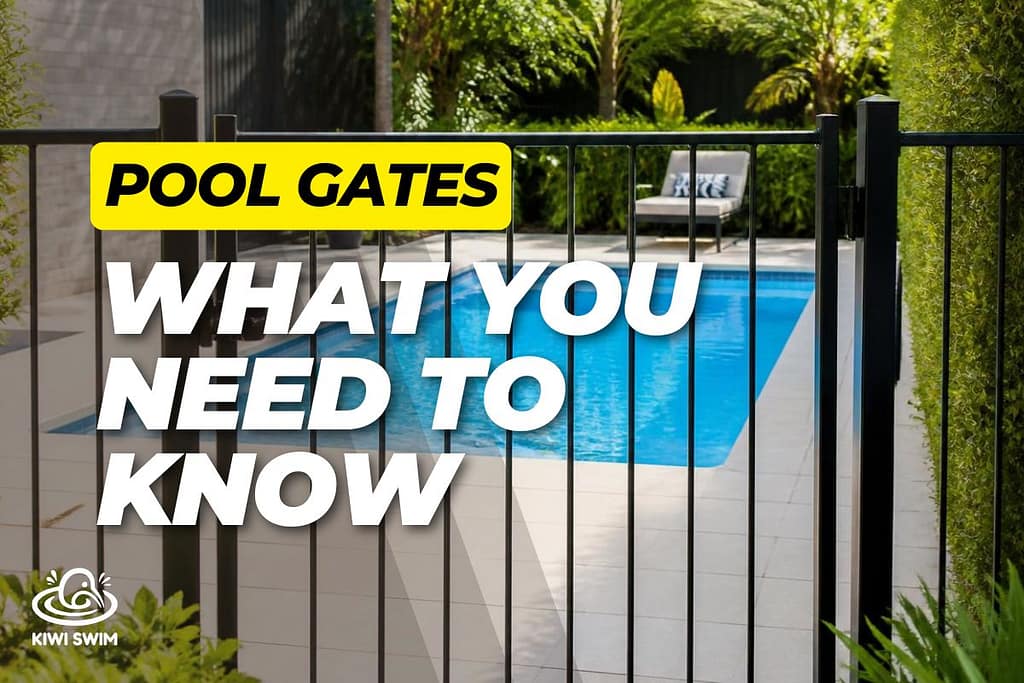
If you have a swimming pool in New Zealand, the pool gate is one of the most important parts of the entire pool barrier. It isn’t simply an entry point into the pool area. It has to help prevent unsupervised access by young children and meet specific requirements under the New Zealand Building Code.
A compliant pool gate needs to be high enough, open in the correct direction, close automatically and latch securely without relying on someone remembering to shut it.
There are several options available, including glass, aluminium and other framed gates, but appearance shouldn’t be the only consideration. The layout of your pool area, surrounding ground, fence design, latch position and how the gate actually behaves in everyday use all matter.
Here’s what you need to know if you’re installing, replacing or checking a pool gate in New Zealand.
What Is a Pool Gate?
A pool gate is a gate incorporated into a barrier that restricts access to a residential swimming pool or its immediate pool area.
Under New Zealand Building Code Clause F9, residential pools that are 400 mm or more in maximum depth must have physical barriers that restrict unsupervised access by children under five.
That means a pool safety gate isn’t treated like an ordinary garden gate.
It forms part of the overall safety barrier, so its construction and operation are important.
For a typical residential pool, a compliant gate needs to:
- Be at least 1.2 metres high.
- Open away from the pool.
- Self-close.
- Self-latch.
- Have a latch that cannot readily be reached by a young child from outside the pool area.
- Be free from obstructions that could hold it open.
- Maintain the required clearances around the gate.
These requirements apply to gates providing access to the pool area, regardless of whether the gate is made from glass, aluminium or another suitable material.
What to Know Before Installing a Pool Gate
Before choosing a gate based on its appearance, look at the entire area around the pool.
This is particularly important because a pool gate can be perfectly good on its own but still create a compliance problem when installed in the wrong location.
Consider:
- Where the gate will be positioned.
- The direction it needs to swing.
- The surrounding fence.
- Ground levels and slopes.
- Steps and retaining walls.
- Nearby garden furniture.
- Trees and landscaping.
- The position of the gate latch.
- Whether anything could prevent the gate from closing.
- Whether the finished installation will form a compliant pool barrier.
A common mistake is concentrating on the gate itself while overlooking what’s immediately beside it.
For example, a planter, retaining wall, raised garden bed or other permanent object may affect how the barrier works or provide a potential climbing opportunity.
MBIE specifically requires pool barriers to restrict access by unsupervised children and considers the surrounding area as part of the overall barrier arrangement.
If you’re installing a completely new barrier, it’s worth getting the layout checked before anything is permanently installed. Changing a post or gate position afterwards can be considerably more complicated than getting it right at the beginning.
Pool Gate Requirements in New Zealand
The exact requirements depend on the barrier design and circumstances, so you shouldn’t assume every pool gate can be made compliant by simply making it 1.2 metres high.
However, the standard F9/AS1 approach provides some useful practical requirements for gates.
The gate must be at least 1.2 metres high
Under F9/AS1, a gate forming part of a pool barrier must be at least 1.2 metres high.
The measurement and surrounding barrier arrangement can become more complicated where there are slopes, retaining walls, raised surfaces or other features, so don’t rely on measuring the gate alone.
The gate must open away from the pool
A pool gate must open away from the pool.
In practical terms, you shouldn’t have a gate that can swing into the pool area.
This also helps prevent someone accidentally pushing the gate towards the pool and leaving it in an unsafe position.
The gate must self-close
A self closing pool gate needs to return to the closed position automatically.
This is important because relying on people to remember to close the gate isn’t considered an adequate safety measure.
The F9/AS1 acceptable solution requires the self-closing device to return the gate to the closed and latched position from any stationary starting position.
The gate must self-latch
Self-closing isn’t enough if the gate doesn’t latch.
The latch needs to operate automatically when the gate closes and require manual operation to release it.
This is one of the things I would pay particular attention to when checking an existing gate.
A gate might look as though it is closed when the latch hasn’t actually engaged.
The latch must not be accessible to children
The latch needs to be positioned so a young child cannot readily reach and operate it from outside the pool area.
MBIE’s current homeowner checklist identifies a latch position of 1,500 mm high or a suitable position on the inside of the gate as ways of addressing this requirement. It also notes that the latch must not be capable of being released from outside through gaps using an object.
This is one reason pool gate hardware can look quite different from ordinary garden gate hardware.
Types of Pool Gates
There isn’t one particular material that every pool must use. The important thing is that the finished barrier and gate comply with the applicable requirements.
Here are some of the common options.
| Pool gate type | Advantages | Things to consider |
|---|---|---|
| Glass pool gate | Clean appearance, suits modern pools, good visibility | Can be expensive and requires careful installation |
| Aluminium gate | Lightweight, corrosion-resistant options available, versatile | Appearance varies considerably between products |
| Framed metal gate | Strong and practical, many design options | Frame and gaps need to be suitable for the barrier |
| Timber gate | Can suit existing timber fencing | Durability and maintenance need consideration |
| Custom gate | Can be designed around unusual layouts | Compliance needs to be considered during the design |
Glass pool gate
Glass is particularly popular around modern pools because it provides a relatively unobstructed view of the pool area.
A glass pool gate can look excellent, particularly alongside frameless or semi-frameless glass fencing.
The downside is that glass fencing and gates can be more expensive than simpler fencing systems, and installation needs to be done properly.
Don’t choose a glass gate purely because it looks good in a showroom. The hardware, hinges, latch, surrounding panels and ground conditions all contribute to whether the finished installation works properly.
Aluminium pool gates
Aluminium is another common choice.
It’s relatively lightweight and can be manufactured in different styles. Powder-coated aluminium can also be a practical choice for outdoor environments.
For coastal properties, I would pay particular attention to the quality of the finish and hardware because salt-laden air can be hard on outdoor metalwork.
Timber pool gates
Timber can work well where the rest of the barrier is timber or where you’re trying to maintain a particular look.
The important thing is that the gate still performs as a pool barrier.
Timber can also move over time as it weathers, which is worth remembering when you’re dealing with a self-closing and self-latching gate. A gate that worked perfectly when installed may eventually start rubbing, sagging or failing to latch properly.
Pool Gates and Fences Need to Work Together
It’s easy to think about pool gates and fences as two separate things.
They’re actually one safety system.
The gate needs to work with the surrounding fence, including:
- Fence height.
- Ground clearance.
- Gaps.
- Nearby structures.
- Climbable objects.
- Gate posts.
- Hinges.
- Latch position.
- The area immediately outside the barrier.
A particularly important point is that the gate shouldn’t be able to remain open because it catches on a fence, wall, plant, furniture or other obstruction.
MBIE’s homeowner checklist specifically asks whether the area around the gate is clear so the gate cannot be held open.
What About Retractable Pool Gates?
You’ll sometimes see retractable pool gate systems marketed as a convenient alternative to conventional hinged gates.
Be careful here.
The Building Code requires physical barriers that restrict access to residential pools, and the acceptable solution for a gate in a pool barrier specifies that the gate shall be hinged.
That doesn’t mean every product marketed as a retractable barrier is automatically prohibited in every possible situation. It does mean you shouldn’t assume a retractable product is compliant simply because it is advertised as a pool safety barrier.
If you’re considering one, get confirmation that the proposed installation complies with the applicable Building Code requirements before purchasing or installing it.
For a conventional residential pool, a properly designed hinged gate is the straightforward approach.
Common Pool Gate Problems I See
A pool gate doesn’t necessarily stay compliant forever.
This is where regular checks are worthwhile.
The gate starts dragging
Ground movement, settling, worn hinges or changes to the gate itself can cause it to rub on the ground.
That can prevent it from closing properly.
The gate no longer latches
This can happen because the gate has sagged slightly, the latch has moved, or the hardware has become worn.
Don’t ignore it just because the gate still looks closed.
The latch needs to actually engage.
The self-closing mechanism becomes weak
Hinges and closing mechanisms can wear over time.
If you have to give the gate a push to get it to close, that’s a warning sign.
Landscaping gets in the way
Plants grow, outdoor furniture gets moved and gardens change.
Something that wasn’t there when the pool fence was installed can eventually interfere with the gate.
The latch becomes easier to reach
Changes to the surrounding area can also affect latch accessibility.
A new planter box, step or other object could potentially change the relationship between the ground and the latch.
How to Check Your Pool Gate
You don’t need to wait until a formal inspection to notice obvious problems.
I’d regularly check that:
- The gate opens away from the pool.
- It swings freely without hitting anything.
- It closes by itself from different positions.
- The latch engages every time.
- The latch cannot readily be reached by a young child from outside.
- Nothing has been placed beside the gate that could assist climbing.
- There isn’t excessive movement in the hinges or posts.
- The gate hasn’t dropped or started rubbing on the ground.
- The surrounding barrier remains in good condition.
- Nothing has changed around the barrier since it was installed.
MBIE provides a specific homeowner pool barrier inspection checklist, which is useful for checking the condition of an existing barrier.
Remember that this is a practical check, not a substitute for the required inspections or professional assessment where compliance is uncertain.
Pool Gate Maintenance
Pool gates don’t generally require complicated maintenance, but they do need to remain functional.
Keep the hinges and closing hardware in good condition according to the manufacturer’s instructions.
Check for:
- Rust or corrosion.
- Loose screws and fixings.
- Cracked or damaged components.
- Sagging.
- Gate movement.
- Damaged glass.
- Worn hinges.
- A latch that doesn’t engage cleanly.
- A closing mechanism that has become weak.
Don’t modify safety-critical gate hardware casually.
If you’re unsure whether a component can be adjusted or replaced without affecting compliance, have the gate assessed.
Pool Gate Regulations and Inspections in NZ
New Zealand’s pool barrier requirements are covered by Building Code Clause F9.
The purpose is to prevent unsupervised access to residential pools by children under five.
Residential pool barriers are subject to ongoing requirements, not just requirements at the time the pool is first installed. Existing pools can also have specific considerations depending on when they were approved and what requirements applied at that time.
Residential pool barriers are generally inspected every three years by a territorial authority or independently qualified pool inspector.
This is worth keeping in mind if you’re buying a house with an existing pool. Don’t assume that an old pool gate is compliant simply because it has been there for years.
Building work involving a residential pool can also require building consent, and importantly, even where the pool itself is exempt from consent under certain circumstances, the barrier can still require consent.
Because individual properties can be complicated, particularly where a house, boundary fence, deck or retaining wall forms part of the barrier, it’s sensible to check with your council or a qualified pool barrier professional before starting work.
Common Mistakes Pool Owners Make
Treating a pool gate like an ordinary gate
A normal garden gate doesn’t necessarily meet pool barrier requirements.
Pool gates have specific requirements around opening direction, self-closing, latching and child access.
Assuming a self-closing gate is automatically compliant
It also needs to latch properly and have the correct latch arrangement.
Ignoring a gate that has started rubbing
A gate that gradually becomes harder to close can eventually stop latching.
Fix the problem rather than simply pushing the gate harder.
Adding furniture beside the gate
A chair, table, storage box or planter shouldn’t become something that interferes with the gate or assists a child in getting over the barrier.
Changing the landscaping without checking the barrier
Raising the ground level, installing garden beds or adding steps around the pool can change the barrier arrangement.
Buying a gate before checking the layout
This is probably the biggest practical mistake.
The gate should be selected as part of the complete barrier rather than purchased first and then forced into whatever space is available.
When to Call a Professional
There’s plenty you can check yourself, but I’d get professional advice when you’re dealing with:
- A new pool barrier.
- A new pool gate.
- An unusual pool layout.
- Sloping or raised ground.
- A barrier involving the house.
- Boundary fences forming part of the barrier.
- Decks or retaining walls near the pool.
- A gate that repeatedly fails to self-close or latch.
- Structural movement.
- Uncertainty about Building Code compliance.
- A failed pool barrier inspection.
Electrical work around a pool is also a separate safety issue and should be handled by an appropriately qualified person.
If you’re replacing an existing gate, don’t assume that installing a newer-looking gate automatically brings the whole barrier into compliance.
Frequently Asked Questions
How high does a pool gate need to be in NZ?
Under the F9/AS1 acceptable solution, a gate forming part of a residential pool barrier must be at least 1.2 metres high. The surrounding barrier and site layout also need to meet the applicable requirements.
Does a pool gate have to self-close in New Zealand?
Yes. Gates forming part of the pool barrier need to automatically return to the closed position, and under the F9/AS1 acceptable solution the self-closing device must return the gate to the closed and latched position.
Does a pool gate have to open outwards?
Yes. A gate in a pool barrier must open away from the pool.
Can I use a glass pool gate?
Yes, glass can be used as part of a pool barrier when the complete installation meets the applicable requirements. The glass, posts, hinges, latch and surrounding barrier all need to be considered as part of the system.
Do pool gates need to be inspected?
Residential pool barriers are generally subject to inspection every three years by the territorial authority or an independently qualified pool inspector.
Can I install a retractable pool gate?
Don’t assume that a retractable product is automatically compliant. The F9/AS1 acceptable solution specifies hinged gates, so if you’re considering a retractable system, check the proposed installation and compliance requirements before buying it.
Choosing the Right Pool Gate
A pool gate might look like a relatively small part of your swimming pool setup, but it’s actually a critical part of the barrier protecting the pool.
When choosing a gate for a pool, don’t start with colour or appearance. Start with the site and the safety requirements.
The gate needs to work properly every single time. It should open away from the pool, close automatically, latch securely and remain difficult for a young child to operate. The surrounding fence, ground, landscaping and other structures need to work with it rather than against it.
Whether you choose a glass pool gate, aluminium gate or another suitable design, getting the complete installation right is far more important than simply choosing the nicest-looking gate.
If you’re installing or replacing a pool gate in New Zealand, check the current requirements before starting work and get professional advice where the layout or compliance is unclear. A properly designed pool gate is one of those pool features you shouldn’t have to think about once it’s installed, because it should simply work every time.