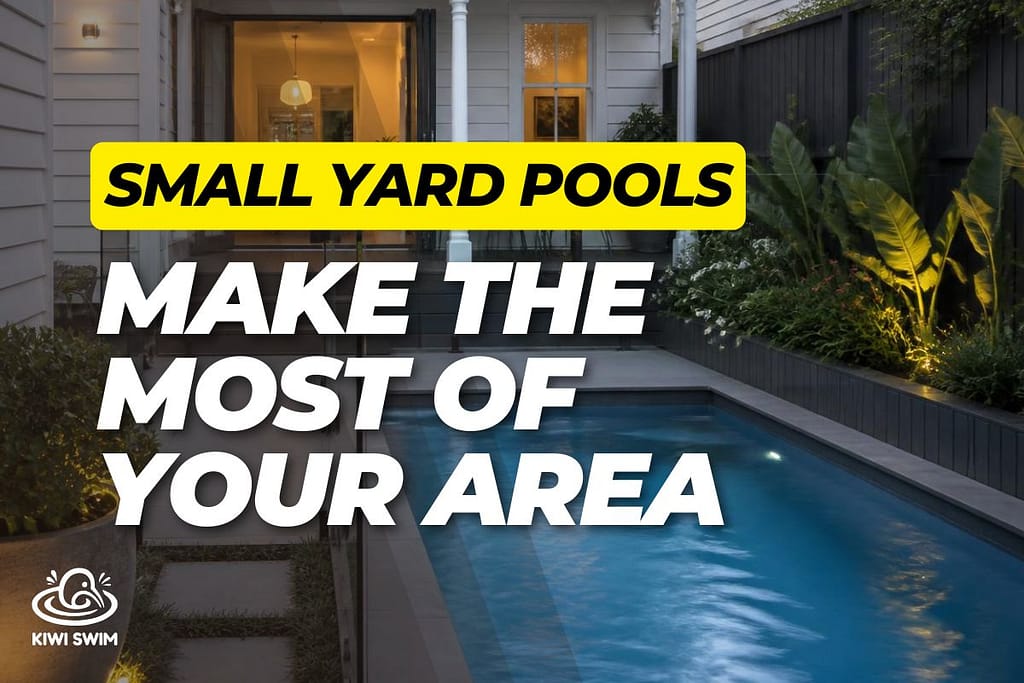
A small backyard doesn’t mean you have to give up on owning a swimming pool. In fact, smaller sections are one of the reasons compact pools, plunge pools and other space-efficient designs have become increasingly popular in New Zealand.
The best swimming pool ideas for small backyards focus on making the most of the space you actually have. That might mean a compact plunge pool, a narrow lap-style pool, a small fibreglass pool, a concrete pool designed specifically around your section, or even an above-ground option.
The key is choosing a pool that suits how you’ll actually use it. A pool that looks great in a photo isn’t necessarily the best choice if it leaves no room for entertaining, creates difficult access around the house or costs far more to install than expected.
Here’s what to consider before choosing a pool for a small backyard.
Can You Fit a Swimming Pool in a Small Backyard?
Probably, but the size of your section isn’t the only thing that matters.
I’ve seen plenty of smaller backyards where a pool could work well, while some larger properties have awkward layouts, steep sections or access problems that make installation much more difficult.
Before deciding on a pool, look at:
- The usable outdoor space, not just the total section size
- Access for excavation equipment and pool installation
- The location of your house and other structures
- Boundaries and required clearances
- Existing drainage and underground services
- Space needed for fencing or other safety barriers
- Where the pump and filter equipment will go
- Whether you still want space for outdoor furniture, lawns or entertaining
- Sun exposure
- How the pool will actually be used
A compact pool can often fit into an area where a traditional family-sized swimming pool wouldn’t make sense. The challenge is making sure the pool doesn’t dominate the entire backyard.
The Best Types of Pools for Small Backyards
There isn’t one perfect pool for every small yard. Your best option will depend on your budget, available space, access and how you want to use the pool.
| Pool type | Advantages | Disadvantages | Best suited to |
|---|---|---|---|
| Plunge pool | Compact, stylish, good for relaxation | Limited swimming space | Small urban backyards |
| Small fibreglass pool | Quick installation, smooth surface | Limited shapes and sizes | Straightforward sections |
| Concrete pool | Fully customisable | Usually more expensive | Awkward or unusual spaces |
| Narrow lap pool | Good for exercise | Requires length | Long, narrow backyards |
| Cocktail pool | Great for entertaining | Less suitable for serious swimming | Social outdoor spaces |
| Above-ground pool | Often lower installation costs | Can take up significant visual space | Flexible or difficult sites |
Plunge pool ideas
A plunge pool is one of the most popular options for small backyards.
These pools are usually compact and designed more for cooling off, relaxing and entertaining than swimming laps. Depending on the design, they may include seating, jets or heating.
A plunge pool can work particularly well when:
- You have limited outdoor space
- You want somewhere to cool off in summer
- You prefer relaxing over swimming laps
- You want a feature as well as a functional pool
- You want to combine the pool with a deck or entertaining area
Some modern plunge pools are available in compact square or rectangular designs, while others can be custom-built.
The downside is that a plunge pool is still a significant construction project if it’s installed in-ground. Don’t assume that a smaller pool automatically means a cheap pool. Excavation, equipment, fencing, electrical work and landscaping can still represent a large part of the total project.
Small fibreglass pools
Fibreglass can be a good option if you want an inground pool without the design and construction time usually associated with a custom concrete pool.
The shell is manufactured off-site and delivered to your property before installation. This can make the installation process quicker once the site is ready.
The main advantages include:
- Faster installation
- Smooth, non-porous surfaces
- Lower maintenance requirements than some other pool finishes
- A range of compact pool shapes
The biggest limitation is that you’re choosing from available shell sizes and shapes. If your backyard has an awkward layout, a standard shell may not make the best use of the available space.
Access is also important. A fibreglass shell needs to be delivered and positioned on your property, which can be difficult on tight sites with limited access.
Custom concrete pools
Concrete gives you the greatest design flexibility.
If you have an unusually shaped backyard, a narrow space or want the pool to follow the layout of your home and landscaping, a custom concrete pool can make better use of the area.
You can customise:
- Length and width
- Depth
- Shape
- Steps and seating
- Water features
- Pool finishes
- Edge details
Concrete pools can be an excellent solution for small yards because the pool can be designed specifically around the space.
However, they’re generally a more expensive option and the construction process can take longer.
Narrow lap pools
A narrow pool can work surprisingly well in a long, skinny backyard.
Rather than trying to fit a wide traditional pool into a small space, a narrow rectangular pool can provide enough length for swimming while leaving room beside it for access or landscaping.
These swimming pool designs for small yards can work particularly well alongside a house or boundary where the shape of the section naturally creates a long, narrow area.
The main thing to consider is how much of the backyard the pool will consume. A long pool may look fantastic, but you’ll still need to think about access, safety barriers and usable outdoor living space.
Cocktail pools
Cocktail pools are generally compact pools designed more around relaxation and entertaining.
They may include:
- Built-in seating
- Shallow lounging areas
- Jets
- Heating
- Lighting
They’re often deeper and more pool-like than a spa but smaller than a traditional swimming pool.
For homeowners who mainly want somewhere to sit in the water, cool off and enjoy the backyard, a cocktail pool can be a practical compromise.
Above-ground pools
Above-ground pools can be worth considering if excavation is difficult, access is poor or you want a less permanent option.
However, they aren’t always as space-efficient as people expect. A large round above-ground pool can occupy a significant part of a small backyard.
You’ll also need to think carefully about:
- Access into the pool
- Safety barriers
- The visual impact
- Pump and filter placement
- The condition and level of the ground
- How the pool will fit with decking or landscaping
In some situations, an above-ground pool can provide a much simpler installation. In others, building decking, access and compliant barriers can make the project more complicated.
What You Should Know Before Installing a Small Pool
The pool itself is only part of the project.
This is one of the biggest things I recommend thinking about before you start getting excited about pool shapes and finishes. In a small backyard, every part of the installation has to fit somewhere.
Pool equipment still needs space
Even tiny pools need equipment.
You’ll normally need room for equipment such as:
- A pool pump
- A filter
- Plumbing
- Electrical equipment
- A chlorination system or other sanitising equipment
- Possibly a heat pump
The equipment area needs to be accessible for servicing and maintenance.
Don’t design the entire backyard around the pool and then discover there’s nowhere sensible to put the filtration system.
Access can affect the cost
A small pool doesn’t necessarily mean small installation equipment.
Excavators, trucks, cranes and other machinery may still need access to your property. Tight urban sections can make this more difficult and expensive.
Poor access can affect:
- Excavation costs
- Spoil removal
- Delivery costs
- Crane requirements
- Construction time
This is particularly important with fibreglass pools, where the shell needs to be transported and lifted into position.
Don’t forget the space around the pool
A pool that fills every available square metre might technically fit, but that doesn’t always make it the best design.
Think about how you want the backyard to function after the pool is installed.
You may still want:
- Outdoor seating
- A dining area
- Space for children
- Landscaping
- Access around the house
- Somewhere to store pool equipment
In a small yard, sometimes a slightly smaller pool creates a much better overall outdoor space.
Pool Safety and Fencing in New Zealand
Safety requirements need to be considered before you choose your pool, not after it’s already been ordered.
In New Zealand, residential pools capable of holding water to a depth of 400 mm or more generally require a physical barrier that restricts unsupervised access by children under five. This includes permanent, temporary, inflatable and many above-ground pools. Pool barriers and the pool construction itself may have different consent requirements, so it’s important to check the specific requirements for your project with your local council before installation.
For some above-ground pools, the pool walls themselves may form part of the barrier if they meet the required criteria. Pumps, pipes, ladders and other features can also create climbable access, so the whole setup needs to be considered.
Small heated pools, such as some spa pools, may be able to use a compliant safety cover instead of a surrounding barrier when they meet the relevant size, wall height and non-climbability requirements.
Because safety and consent requirements can vary depending on the pool and installation, check with your local council before committing to a design.
Small Backyard Pool Ideas That Make Better Use of Space
The way you design the surrounding area can make a huge difference.
Build the pool close to the house
In some small backyards, positioning the pool near the house can leave a larger usable area elsewhere.
This can also make it easier to create one connected outdoor living area rather than dividing the backyard into several small spaces.
However, structural requirements, drainage, access and consent considerations all need to be properly assessed.
Use rectangular shapes
Rectangular pools are often efficient in small spaces.
They fit neatly alongside:
- Houses
- Decks
- Boundaries
- Outdoor entertaining areas
A simple rectangular design can also make it easier to cover the pool and position fencing.
Combine the pool and entertaining area
Instead of treating the pool as a completely separate feature, design it as part of the outdoor living area.
For example, a compact pool beside a deck can create a backyard that works for both swimming and entertaining.
This is often more practical than trying to fit a large pool, separate deck, lawn and outdoor dining area into a limited space.
Consider built-in seating
Built-in benches and shallow lounging areas can make small pools more versatile.
A pool doesn’t need to be large to be enjoyable if it has enough room to sit, relax and cool off.
Keep landscaping simple
Heavy landscaping can make a small backyard feel even smaller.
That doesn’t mean the area should be bare. A few well-chosen plants, clean paving and a simple layout can make a compact pool area feel much more open.
How Much Does a Small Pool Cost in New Zealand?
Pool costs vary enormously depending on the type of pool, location, access and site conditions.
The final cost isn’t just the pool shell or structure. You may also need to budget for:
- Excavation
- Spoil removal
- Delivery or craneage
- Pool equipment
- Plumbing
- Electrical work
- Heating
- Pool fencing
- Building consent fees
- Paving or decking
- Landscaping
- Drainage
- Site preparation
Current Auckland estimates show how large the difference can be between basic and fully installed projects. For example, recent 2026 estimates for fully installed fibreglass pools range broadly depending on size, access and finishes, while concrete pools generally start at a higher level and can increase substantially with custom design and difficult site conditions.
The most useful approach is to get quotes based on your actual property rather than relying only on advertised starting prices.
A cheap-looking pool price can become much more expensive once excavation, access, fencing and landscaping are added.
Inground Pools vs Above-Ground Pools for Small Yards
Inground pools
Pros:
- Can look more integrated into the backyard
- Wide range of custom options
- Easier to combine with landscaping and paving
- Can make better use of awkward spaces
Cons:
- Higher installation costs
- Excavation required
- More disruption during construction
- Access can be a major issue
Above-ground pools
Pros:
- Can be easier and quicker to install
- May avoid major excavation
- Some options are more affordable
- Can suit difficult sites
Cons:
- Can dominate a small backyard visually
- Still require proper safety planning
- Access and decking may add cost
- May not have the same integrated appearance
Neither option is automatically better. It depends on your budget, site and expectations.
Common Mistakes When Choosing a Pool for a Small Backyard
Choosing the biggest pool that will physically fit
Just because a pool fits doesn’t mean it’s the right size.
Leave enough space for the backyard to remain useful.
Forgetting about fencing
The pool barrier can affect the layout significantly.
Plan it from the beginning rather than trying to squeeze it in afterwards.
Ignoring equipment placement
Pool equipment needs space and access.
Trying to hide everything in an inaccessible corner can create maintenance headaches later.
Underestimating installation costs
The pool itself may only be part of the budget.
Ask what is and isn’t included in every quote.
Choosing a design without considering how you’ll use it
Be honest about whether you want to:
- Swim laps
- Relax
- Entertain
- Cool off
- Exercise
- Give children somewhere to play
A plunge pool might be perfect for one household and disappointing for another.
When to Call a Professional
A professional pool builder, designer or suitably qualified contractor is particularly useful when your project involves:
- Difficult site access
- Sloping land
- Retaining walls
- Structural work
- Complex drainage
- Electrical installation
- Building consent questions
- Custom concrete construction
For a small backyard, professional design advice can be particularly valuable because there is less room for mistakes.
A good design should consider the entire outdoor space, not just where the pool will sit.
Frequently Asked Questions
What is the best pool for a small backyard?
For many small New Zealand backyards, a plunge pool, compact fibreglass pool or custom concrete pool can work well. The best choice depends on your available space, budget, access and how you plan to use the pool.
Can you put a pool in a very small backyard?
Yes, in many cases. Compact plunge pools, narrow pools and custom-designed concrete pools can fit into relatively small spaces. However, you still need to allow for equipment, access and safety barriers.
Are plunge pools cheaper than regular pools?
They can be cheaper overall because they require less material and excavation, but a plunge pool can still be an expensive project once equipment, fencing, electrical work, landscaping and installation are included.
Do small pools need a fence in New Zealand?
Generally, yes if the pool can hold water to a depth of 400 mm or more. This can include permanent, temporary and inflatable pools. Some qualifying small heated pools can use a compliant safety cover instead of a surrounding barrier.
Are above-ground pools suitable for small backyards?
They can be, particularly where excavation is difficult or you want a less permanent option. However, some above-ground pools can take up a surprising amount of space and still require careful planning for access and safety.
Is a concrete or fibreglass pool better for a small backyard?
Fibreglass can be a good choice for straightforward sites where a standard shell fits the available space. Concrete provides more design flexibility and may work better for awkward, narrow or unusually shaped backyards.
Making the Most of a Small Backyard Pool
The best swimming pool ideas for small backyards aren’t necessarily about fitting the largest possible pool into the available space.
A well-designed small pool can be far more enjoyable than a larger pool that takes over the entire backyard.
Start by thinking about how you’ll actually use the pool, then consider the available space, access, equipment location, fencing, installation costs and the rest of your outdoor area.
For some Kiwi homeowners, a compact plunge pool will be the perfect fit. Others may be better off with a narrow lap pool, a small fibreglass design, an above-ground pool or a custom-built concrete pool.
The important thing is to design the whole backyard around how you want to live in it, rather than choosing a pool first and trying to make everything else fit around it.