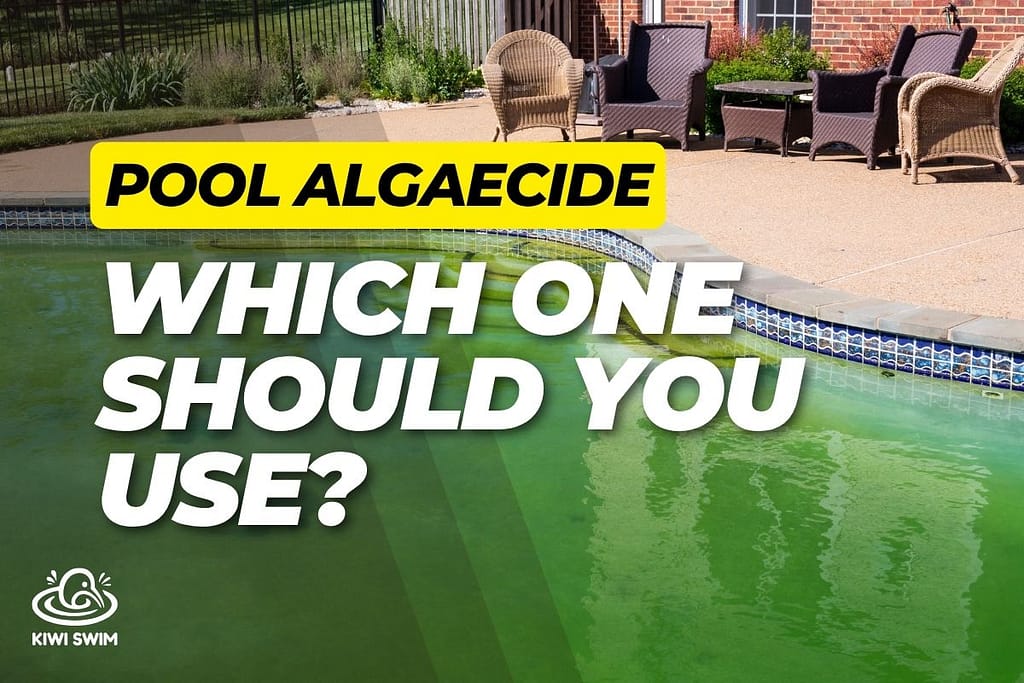
If you’re dealing with green, mustard or black algae in your pool, algaecide can be a useful part of the treatment. But it’s important to understand what algaecide actually does, because it isn’t a substitute for proper chlorine, filtration and water balance.
There are several types of swimming pool algaecide available in New Zealand, including copper-based products, polymer-based products and combination formulas. Some are designed for treating an existing algae problem, while others are better suited to preventing algae or winterising a pool.
The right choice depends on the type of algae you’re dealing with, your pool’s sanitation system and how serious the problem is.
What is algaecide?
Algaecide is a pool chemical designed to control or kill algae growing in swimming pool water.
Algae can enter a pool through the environment and can multiply quickly when conditions are favourable. Warm water, sunlight, poor circulation, inadequate sanitiser levels and unbalanced water can all contribute to an outbreak.
Algaecides work in different ways depending on their active ingredients. Some attack algae directly, while others interfere with its ability to grow and reproduce.
The important thing to understand is that algaecide works alongside your pool’s normal sanitation system. It shouldn’t be thought of as a replacement for maintaining an appropriate chlorine level.
Does algaecide kill pool algae?
Yes, some algaecides can kill algae, while others are particularly useful for preventing or controlling further growth.
However, if you’ve got a seriously green pool, simply pouring in algaecide and waiting for the water to clear isn’t usually the best approach.
In practice, successful algae treatment normally involves several things working together:
- Correcting the water balance
- Maintaining effective chlorine levels
- Brushing the pool walls and floor
- Improving circulation
- Removing dead algae through filtration or vacuuming
- Cleaning the filter after a significant algae outbreak
- Using an appropriate algaecide where necessary
This is especially important with established black or mustard algae, which can be much more persistent than ordinary green algae.
When should you use algaecide?
Algaecide is most useful when you have a specific reason to use it rather than simply adding it every time you maintain the pool.
Common situations include:
- An existing algae outbreak
- Persistent algae that keeps returning
- Preventing algae during periods when the pool is not being used
- Winterising a pool
- Helping control particular types of algae
- Maintaining a pool where algae has historically been a problem
If your pool is consistently clear and properly sanitised, you may not need routine algaecide at all.
A common mistake is to use algaecide to compensate for inadequate chlorine or poor circulation. That usually treats the symptom rather than the cause.
Types of swimming pool algaecide
Not all algaecides are the same. The active ingredient matters considerably.
| Type | Main characteristics | Potential advantages | Things to consider |
|---|---|---|---|
| Copper-based | Uses copper compounds to control algae | Effective against several algae types and can provide residual control | Excess copper can contribute to staining |
| Polymer-based | Uses organic polymer compounds rather than copper | Doesn’t introduce copper into the water | Product suitability varies |
| Quaternary ammonium compounds | Often called “quats” | Useful for algae prevention and some treatments | Some formulations can foam |
| Polyquat products | A type of polymeric algaecide | Generally low-foaming and useful for prevention | Check the exact formulation and directions |
| Combination products | May contain copper plus another active ingredient | Can target several types of algae | Greater need to follow the label carefully |
The product label is more important than the marketing name. Two products both called “algaecide” can behave quite differently.
Copper algaecide
Copper-based algaecides are widely used for swimming pools and can be particularly effective against difficult algae.
Some New Zealand products contain copper as their active ingredient. For example, Zodiac’s Pool Long Life Algaecide contains copper in a cupric ammonium complex, while its Pool Power Algaecide combines copper with benzalkonium chloride.
Copper has a major advantage: it can provide effective algae control without relying entirely on oxidising the algae with chlorine.
The downside is that copper needs to be treated with respect.
Too much copper in pool water can contribute to staining, particularly under conditions where the copper becomes less soluble. This is one reason I don’t recommend randomly adding copper-based products simply because an algae problem keeps returning.
If you’re using a copper algaecide, follow the manufacturer’s dosage carefully. Don’t assume that doubling the dose will produce twice the result.
Some manufacturers specifically state maximum copper concentrations. For example, Zodiac’s Pool Power Algaecide specifies that copper concentrations should not exceed 1 mg/L (ppm).
Polyquat 60 and polymer algaecides
Polyquat 60 is a commonly discussed pool algaecide formulation based on a polymeric quaternary ammonium compound.
Polymeric algaecides are attractive because they don’t add copper to the water. This can be useful if you’re trying to avoid introducing metals into the pool.
They can be particularly useful for algae prevention and as part of a winterising programme.
However, don’t assume that every product described as a polymer or quat is interchangeable with Polyquat 60. Concentrations and formulations differ, so dosing should always come from the specific product label.
Waterco New Zealand, for example, sells a metal-free AquaPure General Purpose Algaecide and Clarifier designed for swimming pools, fountains and ponds. The manufacturer also describes it as suitable for off-season winterising.
What is the best algaecide for pools?
There isn’t one best algaecide for pools in every situation.
I’d choose based on the problem you’re actually trying to solve.
For example:
- Routine algae prevention: a suitable polymeric algaecide may make sense.
- Winterising: look for a product specifically designed for winter or off-season treatment.
- Green algae: several types of algaecide can be effective, but proper chlorine and filtration remain critical.
- Mustard algae: choose a product whose label specifically covers mustard algae.
- Black algae: look for a product specifically intended for black algae or black spot, and combine it with aggressive physical removal and proper sanitation.
- A copper-sensitive pool: consider a metal-free polymer product.
- A fountain: use a product specifically labelled for fountains and follow its instructions.
The cheapest bottle isn’t necessarily the cheapest treatment. A highly concentrated product may cost more initially but require considerably less product per 10,000 litres.
Algaecide for green algae
Green algae is the type most pool owners encounter.
It can turn the water green and may also form slippery green growth on walls and floors.
Before reaching for algaecide, check the basics:
- Test the pool water.
- Check that the chlorine level is appropriate.
- Check the pH.
- Brush the walls and floor thoroughly.
- Make sure the circulation system is operating correctly.
- Clean or backwash the filter when required.
- Use an appropriate algae treatment if necessary.
Don’t underestimate brushing. Algae can attach itself firmly to pool surfaces, and simply adding chemicals doesn’t physically remove that growth.
Some algaecide manufacturers specifically recommend brushing before and after treatment. Zodiac also recommends checking and correcting pH because chlorine becomes less effective as pH rises.
Mustard algae treatment
Mustard algae can be particularly frustrating because it can look like ordinary dirt or yellow-brown dust.
It often appears on pool walls, floors and shaded areas and may return surprisingly quickly after the pool appears clean.
If you suspect mustard algae, don’t simply keep adding algaecide.
A sensible approach is to:
- Thoroughly brush affected surfaces.
- Ensure the pool is properly sanitised.
- Clean pool equipment that may have been exposed to the algae.
- Pay particular attention to areas with poor circulation.
- Follow the treatment instructions for the specific algaecide.
- Clean the filter after the treatment where appropriate.
Some products available in New Zealand are specifically marketed for green, green-blue and mustard algae.
If the algae repeatedly returns despite apparently correct chemistry, it’s worth looking for the underlying reason rather than continually increasing chemical doses.
Black algae killer for pools
Black algae is one of the harder algae problems to deal with.
Despite its name, black algae is often seen as small dark spots firmly attached to the pool surface. It can be particularly stubborn because simply killing the visible surface growth doesn’t necessarily solve the entire problem.
For this reason, the best black algae killer for pools isn’t simply the strongest chemical you can find.
Physical treatment matters enormously.
Brush or scrub affected areas thoroughly and maintain effective sanitation. Some algaecides are specifically labelled for black algae or black spot, so check the manufacturer’s instructions before purchasing.
Zodiac’s New Zealand algaecide products, for example, specifically list black spot among the problems they are designed to address.
If black algae continues to return, particularly in cracks, porous surfaces or damaged finishes, professional advice may be worthwhile.
Algaecide for salt water pools
You can use algaecide in many salt water pools, but you need to choose the product carefully.
A salt chlorinator still produces chlorine, so the pool should continue to be managed as a chlorine pool. The presence of salt doesn’t mean algae cannot grow.
In fact, if a salt pool develops algae, I’d first investigate the chlorination system before automatically adding more chemicals.
Check:
- Chlorinator output
- Cell condition
- Chlorine level
- Stabiliser level
- pH
- Pump run time
- Water circulation
- Filter condition
If the chlorinator isn’t producing enough chlorine, algaecide may help with the immediate problem but won’t fix the underlying issue.
Also check the algaecide label for compatibility with salt chlorination and follow the manufacturer’s instructions.
Winter algaecide
A winter algaecide is intended to help control algae during periods when a pool is being used less frequently or is being winterised.
This can be useful in New Zealand because many residential pools receive considerably less attention during the colder months.
The idea isn’t to shut the pool down completely and expect one chemical to keep everything perfect.
Before winterising, you should still:
- Balance the water.
- Ensure the pool is properly sanitised.
- Clean the pool.
- Clean or service the filter as appropriate.
- Maintain suitable circulation.
- Add winterising chemicals according to the product instructions.
Some products are specifically marketed for long-term algae control and winterising.
Can you use natural algaecide?
You’ll sometimes see products described as natural algaecide, particularly online.
Be careful with the word “natural”. Natural doesn’t automatically mean safe, effective or suitable for a swimming pool.
If you’re considering a natural algae treatment, look at the actual active ingredients and make sure the product is specifically intended for swimming pool use.
I wouldn’t recommend putting household substances, essential oils, plant extracts or homemade mixtures into a swimming pool simply because they’re described as natural.
Your pool’s filtration system, sanitiser and water chemistry are designed to work together. An untested home remedy can create a new water-quality problem while failing to solve the algae.
Algaecide for hot tubs and spas
An algaecide for hot tubs isn’t necessarily the same product you’d choose for a swimming pool.
Hot tubs have much smaller water volumes, higher temperatures and different circulation and bather-load conditions.
If algae is appearing in a spa or hot tub, first check the sanitation system and water chemistry. A dirty or poorly sanitised spa can develop problems very quickly.
Only use an algaecide if the product is specifically approved or labelled for that type of water system. Often, draining your spa and refilling it with fresh water is the best solution to a spa with algae.
Algaecide for fountains
Fountains can have very different requirements from swimming pools.
A fountain may not have the same filtration, circulation or sanitation system as a swimming pool, and the water may not be intended for bathing.
There are products specifically formulated for fountains and ornamental water features. Waterco’s AquaPure General Purpose Algaecide, for example, is marketed for swimming pools, fountains and ponds.
Don’t assume a pool chemical is automatically suitable for every fountain, particularly if the fountain contains fish, plants or other aquatic life.
Common algaecide mistakes pool owners make
Using algaecide instead of fixing chlorine
If your chlorine level is consistently inadequate, algae will keep coming back.
Find out why the chlorine isn’t being maintained before relying on algaecide.
Adding more than the label says
More isn’t necessarily better.
This is particularly important with copper-containing products because excessive metal levels can create other problems.
Ignoring the filter
Dead algae has to go somewhere.
A filter can become heavily loaded after an algae treatment. If you don’t clean it appropriately, the pool may remain cloudy or algae can be redistributed through the circulation system.
Not brushing
Chemical treatment doesn’t eliminate the need for physical cleaning.
Brushing helps break algae away from surfaces and exposes it to the sanitising chemicals.
Adding chemicals without testing
You should know what’s happening with the pool water before deciding what treatment it needs.
Treating recurring algae without investigating the cause
If algae keeps returning, look at circulation, filtration, chlorine production, stabiliser, water balance, pool surfaces and areas of poor circulation.
Is algaecide safe?
Pool chemicals can be hazardous if they’re handled or stored incorrectly.
New Zealand’s Environmental Protection Authority recommends following the product label, using appropriate protective equipment and keeping pool chemicals away from children, pets, heat, fire, electricity and incompatible chemicals. It also specifically warns never to mix different pool chemicals together because dangerous gases or explosions can result.
When using algaecide:
- Read the entire label before use.
- Follow the specified dose.
- Wear the recommended protective equipment.
- Don’t mix chemicals together.
- Store chemicals securely.
- Keep chemicals in their original containers.
- Follow the manufacturer’s instructions regarding swimming after treatment.
If you’re unsure about a product, obtain its safety data sheet and check the manufacturer’s directions before using it.
When to call a pool professional
Most straightforward algae problems can be managed by a capable pool owner.
I’d consider getting professional help when:
- Black algae keeps returning.
- The pool remains green despite correct treatment.
- You can’t establish why chlorine is disappearing.
- The pool has persistent circulation problems.
- The filter isn’t operating correctly.
- You’re dealing with severe staining.
- You suspect excessive copper or other metals in the water.
- You’re unsure whether chemicals are compatible with your particular pool system.
A good pool technician should look at the whole system rather than simply recommending another bottle of chemical.
Frequently Asked Questions
Does algaecide replace chlorine?
No. Algaecide is generally used alongside a properly maintained sanitation system. It shouldn’t be used as a substitute for maintaining appropriate chlorine levels.
What is the best algaecide for pools?
There isn’t one best product for every pool. The right choice depends on the type of algae, whether you’re treating or preventing algae, your pool’s sanitation system and whether you want to introduce copper into the water.
Is copper algaecide better than non-copper algaecide?
Not necessarily. Copper can be highly effective, but excessive copper can contribute to staining. Metal-free polymer products can be a useful alternative when you want to avoid adding copper.
Can I use algaecide in a salt water pool?
Many algaecides can be used in salt water pools, but check the product label for compatibility. Before treating algae, also check that the salt chlorinator is producing sufficient chlorine and that the pool is correctly balanced.
What is the best black algae killer for pools?
A product specifically labelled for black algae or black spot can help, but successful treatment usually requires physical brushing or scrubbing as well as proper sanitation. Black algae is much more difficult to control if it has become firmly established.
Can I use algaecide in winter?
Yes, products specifically designed for winterising can help control algae while a pool is being used less frequently. The pool should still be properly cleaned, balanced and sanitised before winter treatment.
The bottom line on algaecide
Algaecide is a useful pool chemical, but it’s not a magic solution for a poorly maintained pool.
If algae is appearing, first look at the fundamentals: chlorine, pH, circulation, filtration and physical cleaning. Once those are under control, the right algaecide can be very useful for treating persistent algae or preventing it from returning.
Copper-based products can be effective, while polymer and polyquat-type products offer alternatives when you don’t want to introduce copper. For mustard or black algae, choose a product specifically intended for the problem and don’t underestimate the importance of brushing and proper sanitation.
For New Zealand pool owners, the safest approach is straightforward: identify the algae problem, choose an algaecide that is appropriate for your pool, follow the product label precisely and fix whatever allowed the algae to take hold in the first place.