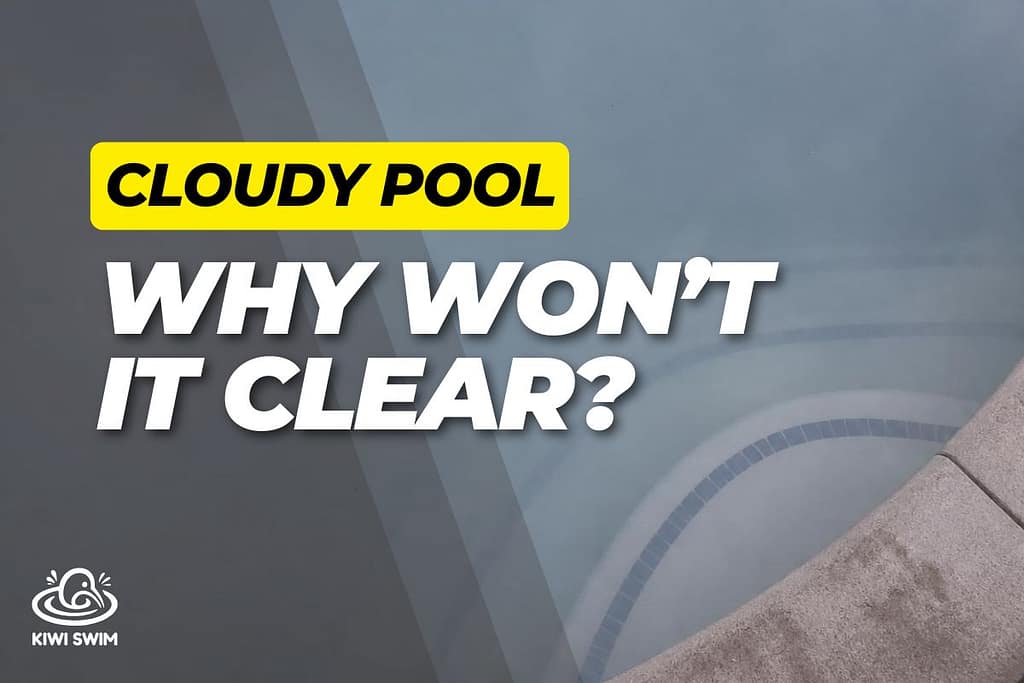
If you’re thinking, “my pool is cloudy”, the good news is that cloudy water is usually fixable once you identify what is causing it.
Cloudy pool water is often caused by a combination of poor filtration, low or unstable chlorine, incorrect pH, algae, debris, rain or a high bather load. Sometimes the water can even look perfectly blue while still being cloudy because there are tiny particles suspended throughout the water.
The important thing is not to keep adding chemicals at random. In my experience, cloudy water is much easier to clear when you work through the basics in the right order: test the water, check the filter and circulation, correct the chemistry, then give the pool enough time to filter the suspended particles out.
Why is my pool cloudy?
A cloudy pool is water that has lost its normal clarity because very small particles are suspended in the water instead of being removed by the filtration system.
Those particles can come from several sources, including:
- Dirt and dust
- Dead algae
- Organic debris
- Sunscreen, body oils and other swimmer waste
- Fine particles introduced by rain
- Poorly balanced pool water
- Calcium or other mineral deposits
- Inadequate filtration or circulation
There isn’t always one single cause. A pool can have low chlorine, for example, which allows algae and organic material to build up, while a dirty filter then prevents the resulting particles from being removed efficiently.
That’s why simply adding more chlorine doesn’t always clear a cloudy pool.
My pool is cloudy but blue. What does that mean?
If your pool is still blue but looks hazy, milky or slightly dull, that’s generally a better situation than a pool that has turned green.
A blue but cloudy pool often has very fine particles suspended in the water. These could be dead algae, dust, debris or other material that the filter hasn’t removed yet.
This can happen after treating an algae problem. The chlorine may have killed the algae, but killing it doesn’t make it disappear. The dead material still has to be removed from the water.
Your filtration system is essentially doing the clean-up work.
If the water is blue but cloudy and your chlorine and pH are properly balanced, the solution may simply be good circulation and enough filtration time rather than adding another chemical.
What causes cloudy pool water?
Low or inadequate chlorine
Chlorine is responsible for sanitising your pool and helping control organic contamination and algae.
If the chlorine level has fallen too low, contaminants can accumulate and the water can begin to look dull or cloudy. This is particularly common after heavy swimming, hot weather, long periods without maintenance or a period of rain.
Test the water rather than guessing how much chlorine is needed. Your target levels should be based on your pool system, sanitiser and manufacturer’s recommendations.
If you use a salt chlorinator, also remember that the chlorinator needs adequate operating time and the correct salt level to produce chlorine effectively.
Incorrect pH
pH affects how effectively chlorine works and can also contribute to water clarity problems when it gets significantly out of balance.
A pool with persistently high pH can also be more prone to calcium-related cloudiness and scaling.
Rather than repeatedly shocking the pool, test the pH and make any necessary adjustment according to your pool chemical manufacturer’s instructions.
Poor filtration
Your filter is one of the most important pieces of equipment when you’re trying to clear cloudy water.
Think of it this way: the chemicals deal with the contaminants, while the filter physically removes many of the particles left floating in the water.
If the filter is dirty, damaged, undersized or not being run for long enough, the pool may struggle to clear.
Check:
- Whether the filter needs cleaning or backwashing
- Whether the pump is running correctly
- Whether the water is circulating properly
- Whether the filter pressure is higher than normal
- Whether the filter media needs attention
- Whether the pump basket and skimmer basket are blocked
For cartridge filters, follow the manufacturer’s cleaning procedure. A cartridge filter should not simply be treated like a sand filter and backwashed.
Algae
Cloudiness is sometimes the early warning sign of an algae problem.
The pool doesn’t necessarily have to look green. Algae can begin growing while the water is still blue, particularly when chlorine has been inadequate.
If you notice a greenish tinge, slippery surfaces, algae on the walls or rapidly returning cloudiness, look at sanitation as a likely part of the problem.
Killing the algae is only part of the job. Once the algae has died, the filter still needs to remove the resulting debris.
Rain and stormwater
Heavy rain can introduce dirt, dust, organic material and other contaminants into a pool.
Rain can also dilute pool chemicals and increase the amount of material your filter has to deal with.
This is one reason cloudy pool water after rain is relatively common.
After significant rainfall, check your water chemistry and make sure the filtration system is operating properly. Don’t automatically dump a large amount of chemicals into the pool without testing first.
In Auckland, Watercare also has specific rules around topping up and filling pools during water restrictions, so check the current restrictions before adding significant amounts of mains water.
Heavy swimming or contamination
A busy pool can become cloudy surprisingly quickly.
Swimmers introduce:
- Sweat
- Body oils
- Sunscreen
- Dirt
- Hair and skin particles
- Other organic contaminants
A pool that has had a large number of swimmers may need additional filtration and appropriate chemical adjustment afterwards.
Calcium and mineral problems
Sometimes cloudy water is related to the mineral balance of the pool rather than dirt or algae.
This is more likely when the water chemistry has been significantly out of balance or when calcium levels are inappropriate for the particular pool.
If cloudiness repeatedly returns despite good chlorine, pH, circulation and filtration, it can be worth having a more comprehensive water test performed rather than continually adding clarifier.
My pool is cloudy after shocking it
If your pool is cloudy after shocking it, don’t immediately assume the shock has made the problem worse.
A common situation is that the shock has killed algae or oxidised organic contaminants, leaving a large amount of microscopic material suspended in the water.
The pool can therefore look worse temporarily even though the underlying problem is being dealt with.
The next step is usually filtration.
Keep the water circulating and make sure the filter is functioning properly. Check the filter pressure regularly and clean or backwash it according to the filter manufacturer’s instructions.
If the pool was heavily contaminated with algae, it may take considerably longer to become clear than a pool that only had a small amount of suspended debris.
Also remember that more chlorine isn’t necessarily the answer. If you’ve already treated the pool correctly, repeatedly adding more chemicals without testing can create a different water chemistry problem.
How to clear a cloudy pool
If you’re standing beside the pool wondering what to do next, I’d work through these steps.
1. Test the water
Start with your basic water chemistry.
- Free chlorine
- pH
- Total alkalinity
- Stabiliser, where applicable
If the problem has been persistent, a more comprehensive test can be useful.
Don’t rely solely on the appearance of the water to decide what chemicals it needs.
2. Inspect the pool
Have a good look around the pool.
Check for:
- Algae on the walls or floor
- Leaves and debris
- Excessive dirt
- Poor water circulation
- Blocked skimmer baskets
- Blocked pump baskets
- Obvious equipment problems
If you can see algae, the treatment needs to address the algae rather than simply trying to make the water look clearer.
3. Check the filter
Make sure the filter is operating correctly.
If you have a sand filter, check the pressure and backwash when appropriate according to the manufacturer’s instructions.
For a cartridge filter, inspect and clean the cartridge when required.
For other filtration systems, follow the manufacturer’s cleaning and maintenance instructions.
A filter full of debris can’t do its job effectively.
4. Correct the water chemistry
Adjust the chemistry based on your test results and the requirements of your pool and sanitising system.
Avoid the temptation to add several different chemicals at once simply because the water looks bad.
Pool chemicals should always be handled according to their labels and manufacturer instructions. Never mix pool chemicals together.
5. Brush the pool
If there is algae or fine debris attached to the walls and floor, brushing can help move it into suspension so that the circulation and filtration system can deal with it.
Pay particular attention to corners, steps, behind ladders and other areas where circulation can be weaker.
6. Run the filtration system
This is the part many pool owners underestimate.
If the water contains fine suspended particles, the filter needs time to remove them.
Keep an eye on filter pressure while the pool is clearing. If the pressure rises significantly, clean or backwash the filter as appropriate for your system.
7. Consider a clarifier only if appropriate
Pool clarifiers can help in some situations by causing very small particles to combine into larger particles that are easier for the filter to capture.
However, clarifier isn’t a substitute for fixing the underlying problem.
If your chlorine is inadequate, your pH is wrong or your filter isn’t working properly, pouring in clarifier may simply mask the problem temporarily.
Follow the product’s dosage and filtration instructions carefully.
8. Consider flocculant for particularly stubborn water
Flocculant works differently from a normal clarifier. It causes suspended particles to clump together so they can settle out of the water.
This can be useful in some severe cloudiness situations, but it isn’t suitable for every pool or filter setup.
Some flocculants require the settled material to be vacuumed directly to waste. That means you need a filtration system and plumbing arrangement that can actually perform the procedure.
Don’t use flocculant simply because the pool is taking a little while to clear. Good filtration is usually the first approach.
What if the pool stays cloudy after treatment?
If you’ve corrected the chemistry and the pool still won’t clear, stop adding random chemicals and investigate the filtration system.
Persistent cloudiness can point to:
- A filter that isn’t removing fine particles properly
- Damaged filter media
- A damaged cartridge
- Poor circulation
- A pump problem
- Incorrect valve settings
- An ongoing algae problem
- Water chemistry that hasn’t actually been corrected
- Excessive calcium or mineral content
If you’ve been treating the pool correctly for several days and the water isn’t improving, getting the water professionally tested and having the equipment checked can save a lot of time and chemicals.
Common mistakes pool owners make
Adding more and more chlorine without testing
Chlorine is important, but blindly increasing it doesn’t solve every cause of cloudy water.
Test first, then treat according to the results.
Ignoring the filter
It’s surprisingly common to concentrate on chemicals while forgetting that the filter is responsible for physically removing much of the material causing the cloudiness.
Cleaning the filter too aggressively
Filters need cleaning, but follow the manufacturer’s procedure. Incorrect cleaning can damage filter media or cartridges and reduce filtration performance.
Swimming in water that isn’t properly treated
Cloudy water isn’t automatically unsafe, but you shouldn’t use a pool when the water chemistry or sanitation is outside the appropriate range or you can’t properly assess its condition.
Clear water is also important for being able to see the bottom of the pool, which is a practical safety consideration.
Using clarifier as a permanent solution
Clarifier can be useful, but it shouldn’t become the answer every time the pool goes cloudy.
If you repeatedly need it, find out why the pool isn’t staying clear in the first place.
When to call a professional
Most basic cloudy-water problems can be handled by a pool owner who is comfortable testing their water, cleaning their filter and carrying out routine maintenance.
Professional help becomes worthwhile when:
- The pool remains cloudy despite correct treatment
- The water repeatedly turns cloudy
- You suspect a filtration or pump problem
- The filter pressure behaves unusually
- You suspect damaged filter equipment
- You can’t get reliable water test results
- You have a persistent algae problem
- You suspect a significant mineral or water chemistry issue
Electrical faults, pump repairs and other equipment work should be handled by appropriately qualified people where required.
Frequently Asked Questions
How long does it take to clear a cloudy pool?
It depends on the cause. Mild cloudiness caused by fine debris can improve relatively quickly with good filtration, while a pool recovering from a significant algae problem can take considerably longer.
If there is no noticeable improvement after correcting the chemistry and running the filtration system properly, investigate the filter and water balance rather than simply adding more chemicals.
Why is my pool blue but cloudy?
A blue but cloudy pool usually means there are fine particles suspended in the water. Dead algae, dust, organic contaminants and particles that haven’t yet been captured by the filter are common possibilities.
Test the water and make sure your filtration system is operating correctly.
Why is my pool cloudy after shocking it?
Shocking can kill algae and oxidise organic contaminants, leaving dead material and other fine particles suspended in the water. The pool can therefore remain cloudy for a while after treatment.
Keep the water circulating and allow the filter to remove the particles.
Can rain make my pool cloudy?
Yes. Heavy rain can introduce dirt, dust and organic material while also diluting the pool water and affecting its chemistry.
Check the water after significant rainfall and make sure the pool is filtering properly.
Should I add clarifier to a cloudy pool?
A clarifier can help with some types of fine suspended particles, but it isn’t always necessary. First check the chlorine, pH, filtration and circulation.
If the underlying problem is poor filtration or inadequate sanitation, clarifier won’t fix the cause.
Can I swim in a cloudy pool?
If the water is cloudy enough that you can’t clearly see the bottom, it’s best not to swim until the water is clear enough to assess properly and the water chemistry is confirmed to be suitable.
The bottom line if your pool is cloudy
If you’re thinking “my pool is cloudy”, don’t start by throwing every pool chemical you have into it.
Start with the basics: test the water, check for algae and debris, inspect the filter and make sure the pool is circulating properly. Correct the chemistry based on the test results, then give the filtration system enough time to remove the suspended particles.
A pool that is blue but cloudy often needs good filtration and patience, while a pool that has turned cloudy because of algae needs the algae dealt with first.
And if your pool remains cloudy despite doing the basics correctly, that’s when it’s worth looking more closely at the filter, circulation system and water chemistry. Fixing the underlying cause is far better than continually treating the symptom.