Choosing a swimming pool is about more than deciding how big you want it to be. Different pool types suit different properties, budgets, lifestyles and backyard layouts. Some are designed for family fun, others are better for swimming laps, cooling off on a hot day or creating a standout feature in your outdoor space.
In New Zealand, the right pool for your property will depend on factors such as the available space, ground conditions, access for construction equipment, local council requirements and how much maintenance you want to take on.
There are also several ways to classify swimming pools. You can compare them by construction material, installation method, shape, design or intended use. Understanding these differences makes it easier to narrow down your options before speaking with a pool builder.
This guide explores the main types of swimming pools, popular swimming pool designs and styles, and the practical considerations to think about before installing one.
What Are the Main Types of Swimming Pools?
Swimming pools can be grouped into several broad categories. Some describe how a pool is built, while others describe its appearance or purpose.
The main categories include:
- Inground pools: Installed in the ground, often using concrete or a prefabricated fibreglass shell.
- Above-ground pools: Installed on the ground or on a prepared base, generally with less excavation.
- Concrete pools: Custom-built pools that offer considerable flexibility in size, shape and depth.
- Fibreglass pools: Pools made from a prefabricated shell that is transported to the property and installed in an excavated area.
- Vinyl-lined pools: Pools with a structural frame or wall system and a flexible vinyl liner.
- Plunge pools: Compact pools designed mainly for cooling off, relaxing and enjoying the water.
- Lap pools: Long, narrow pools designed for swimming exercise.
- Infinity pools: Pools designed to create the visual effect of water extending to the horizon or surrounding landscape.
- Natural swimming pools: Pools that use a naturalistic design and may use biological filtration systems rather than relying solely on conventional chemical treatment.
These categories overlap. For example, a lap pool can be made from concrete or fibreglass, while an infinity pool is a design feature rather than a separate construction material.
That distinction is useful when comparing options. You might first choose a construction type, then decide on the shape, size and features that suit your backyard.
Inground Swimming Pools
Inground swimming pools are installed below the surrounding ground level and are a popular option for homeowners wanting a permanent backyard pool.
They can be designed for family swimming, entertaining, exercise or as a focal point in a landscaped outdoor area. The final appearance depends on the pool’s construction material, shape, coping, surrounding paving and landscaping.
Advantages of inground pools
- They can be integrated into patios, decks and gardens.
- Many shapes, sizes and depths are possible.
- They can be designed to complement the home’s architecture.
- Permanent installations offer a wide range of equipment and finishing options.
Things to consider
Inground pools usually involve excavation, site preparation and more extensive construction than many above-ground options. Costs can increase if the site has difficult access, steep slopes, retaining requirements, rocky ground or challenging drainage.
In New Zealand, you should also investigate applicable building consent requirements and swimming pool barrier rules before committing to a design.
An inground pool is worth considering if you want a permanent installation and have the space and budget to accommodate the construction work.
Above-Ground Swimming Pools
Above-ground pools sit on top of the ground rather than being fully excavated. Depending on the model, they may use a framed structure, rigid wall panels or another purpose-built support system.
They range from relatively simple seasonal pools to more substantial installations with timber surrounds, decking and dedicated filtration equipment.
Advantages of above-ground pools
- They can require less excavation than inground pools.
- Some models are more affordable to purchase and install.
- They can suit properties where a traditional inground pool is impractical.
- Certain models can be dismantled or relocated, depending on their construction.
Things to consider
The ground beneath the pool must be suitable and level, and the structure needs to be installed according to the manufacturer’s specifications. You should not assume that every above-ground pool can safely be placed on an ordinary lawn.
Appearance, access, durability and the quality of the filtration system also vary between models.
Important for New Zealand homeowners: Do not assume an above-ground pool is exempt from pool fencing requirements because it sits above ground or can be taken apart. The applicable rules depend on the pool and its installation. Check the requirements before buying or installing one.
Above-ground pools can be a practical choice for homeowners who want a swimming area without undertaking the same level of construction as a conventional inground pool.
Concrete, Fibreglass and Vinyl-Lined Pools
The material used to build a swimming pool affects its design flexibility, installation process, finish and long-term maintenance. These are three common construction options worth comparing.
Concrete swimming pools
Concrete pools are built on site and can be customised to suit a wide range of shapes, depths and backyard layouts.
They are particularly useful for unusual sites, bespoke designs and pools that need to fit around existing landscaping or architectural features.
Advantages:
- Extensive freedom over shape, depth and dimensions.
- A wide choice of interior finishes and design features.
- Suitable for custom designs, including infinity edges and integrated steps.
Things to consider:
- Construction is generally more involved and can take longer.
- Initial costs are often higher than for standard prefabricated pools.
- Interior finishes may need resurfacing or renovation over time.
- Surface condition and water chemistry need appropriate ongoing care.
Concrete is worth considering if you have a specific design in mind or your property needs a custom solution.
Fibreglass swimming pools
Fibreglass pools are manufactured as a shell and transported to the property for installation. The shell is lowered into an excavated area and connected to the necessary plumbing and filtration equipment.
Manufacturers offer a range of standard shapes and sizes, often with built-in steps, seating and shallow lounging areas.
Advantages:
- Installation can be quicker than building a comparable concrete pool, provided the site is ready.
- The smooth surface is generally straightforward to clean.
- Standard designs make it easier to compare layouts and features before purchasing.
Things to consider:
- The finished shape and dimensions are limited to available shell designs.
- Access must be suitable for delivering and positioning the shell.
- Transport, excavation, drainage and ground conditions can affect installation costs.
- The shell must be installed according to the manufacturer’s requirements.
Fibreglass is a good option to investigate if you want a permanent inground pool with a familiar, ready-made design.
Vinyl-lined swimming pools
Vinyl-lined pools use a structural frame or wall system with a flexible liner that forms the waterproof interior surface.
They are available in various shapes and sizes, although the options depend on the particular construction system and local availability.
Advantages:
- A range of shapes and dimensions may be available.
- The liner provides a smooth interior finish.
- Replacing the liner can refresh the pool’s appearance without necessarily rebuilding the entire structure.
Things to consider:
- The liner can be damaged by sharp objects or unsuitable cleaning practices.
- Liners eventually need replacement.
- Local availability of installers, replacement liners and parts is worth checking before committing.
If you’re considering a vinyl-lined pool in New Zealand, ask the supplier about expected liner life, replacement costs and who will service it.
Popular Swimming Pool Designs and Styles
Once you have considered construction materials, the next step is deciding how you want the pool to look and function.
The following swimming pool designs each have different strengths. Some focus on appearance, while others make better use of limited space or suit a particular activity.
Rectangular swimming pools
Rectangular pools are one of the most versatile designs. Their straight lines suit modern homes, traditional gardens and outdoor entertaining areas.
They are practical for general swimming, family use and exercise. A longer rectangular pool can also be used for swimming laps, depending on its dimensions.
This shape can make it easier to plan surrounding paving, fencing, pool covers and landscaping.
Freeform swimming pools
Freeform pools use curved or irregular outlines rather than straight sides and right angles. They can create a softer, more natural look and work well with gardens that already have curved paths, planting or irregular boundaries.
The main consideration is how the shape affects usable swimming space. Curves can look attractive but may make some pool covers, cleaning equipment and surrounding paving more complicated to plan.
A freeform design suits homeowners who want the pool to blend into the landscape rather than look like a geometric feature.
Infinity pools
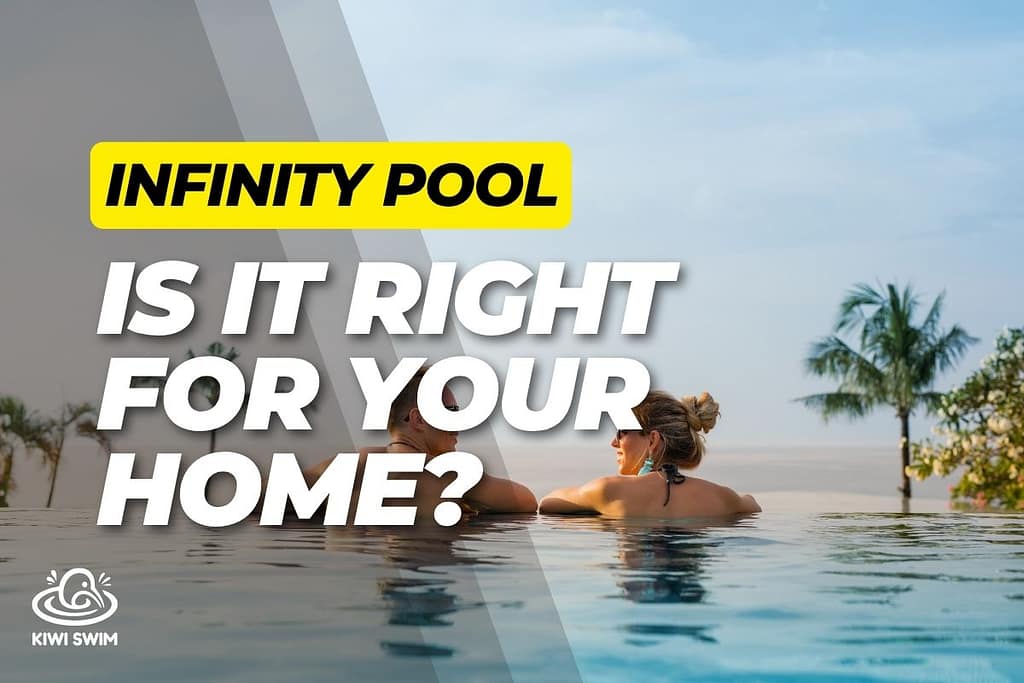
An infinity pool, sometimes called a vanishing-edge pool, is designed so water flows over one or more edges into a concealed collection channel or catch basin. From the right viewing angle, the water can appear to merge with the landscape beyond it.
Infinity designs are especially effective on sloping sites or properties with a view, but they can also be incorporated into other settings.
Things to consider:
- The overflow and water collection system adds complexity.
- The site and viewing angle influence the final effect.
- Installation and maintenance can cost more than a straightforward pool design.
An infinity pool is primarily an architectural feature. It still needs suitable circulation, filtration, water treatment and safe access.
Lap pools
Lap pools are long, relatively narrow pools designed for continuous swimming exercise. They can be a practical option for people who want to swim regularly but do not need a large area for games or entertaining.
Their narrow footprint may suit a long backyard or a strip of space alongside the house.
Think about the length you need for comfortable swimming, how you will enter and exit the pool, and whether you need heating to make year-round exercise more appealing.
Plunge pools
Plunge pools are compact pools designed mainly for cooling off, relaxing and enjoying the water rather than swimming long distances.
They can work well in smaller backyards where a full-sized swimming pool would take up too much space. Some are built inground, while others use raised or partially raised designs.
A smaller pool generally holds less water, but that does not automatically make it cheaper to install. Excavation, access, equipment, decking and safety barriers can still represent a substantial part of the overall cost.
Plunge pools are worth considering if you value having somewhere to cool off and relax more than having room to swim laps.
Natural swimming pools
Natural swimming pools are designed to create a more natural-looking swimming environment, often with planted regeneration areas and biological filtration.
They can appeal to homeowners who want the pool to feel like part of the garden. However, a natural appearance does not mean the water requires no maintenance or that every system operates without treatment equipment.
Designs vary considerably, so ask how the chosen system maintains water quality, how much space is required for filtration or planting, and what routine maintenance involves.
In New Zealand, local climate, shade, falling leaves and the pool’s intended use all need to be considered when planning a natural swimming pool.
Other Swimming Pool Types Worth Considering
Not every pool fits neatly into a construction category or a particular shape. The intended use and the surrounding environment can be just as important.
Indoor swimming pools
Indoor pools allow swimming without direct exposure to the weather. They can be useful for year-round exercise, but the building itself requires careful planning.
Humidity control, ventilation, condensation, heating and corrosion protection are important considerations. Indoor pools also need suitable barriers to restrict access by unsupervised young children.
Heated swimming pools
Heating is a feature rather than a separate pool type. A concrete, fibreglass or other suitable pool can be fitted with a heat pump or another appropriate heating system.
A pool cover can help reduce heat loss and evaporation. Before choosing heating equipment, consider the pool’s volume, desired water temperature, how often it will be used and the cost of running the system.
Saltwater swimming pools
A saltwater pool is still a sanitised swimming pool. Many use a salt chlorinator to produce chlorine from dissolved salt, rather than relying entirely on manually added chlorine.
Saltwater describes the water treatment approach, not the pool’s construction material or shape. Saltwater systems also require water testing, correct chemical balance and equipment maintenance.
How to Choose the Right Swimming Pool for Your Property
The best pool type depends on how you plan to use it and what your property can accommodate. Before choosing a design, consider these practical factors.
| Factor | What to think about |
|---|---|
| Available space | Allow room for the pool, access, fencing, equipment and surrounding areas. |
| Budget | Include site preparation, installation, equipment, landscaping and ongoing running costs. |
| Ground conditions | Slopes, soil, rock, drainage and retaining requirements can influence the design. |
| Access | Excavators, construction materials or a prefabricated pool shell need a suitable route onto the property. |
| Intended use | Family recreation, exercise, cooling off and entertaining may suit different designs. |
| Maintenance | Consider cleaning, water testing, filtration, heating and equipment servicing. |
| Climate | Wind, shade, sun exposure and seasonal temperatures affect comfort and running costs. |
| Safety and compliance | Check pool barrier requirements and any building or planning approvals before installation. |
It is also worth thinking about the area around the pool. Decking, paving, outdoor seating, planting, storage and privacy can have a big effect on how useful the finished space feels.
A smaller pool with a well-planned outdoor area may suit your household better than a larger pool that leaves little room for anything else.
What to Know Before Installing a Swimming Pool in New Zealand
Before paying a deposit or starting excavation, check the requirements that apply to your property and chosen design.
Building consent and council requirements
Building consent requirements depend on the proposed pool and associated work. Do not assume a pool is exempt simply because it is small, prefabricated or above ground. The Ministry of Business, Innovation and Employment’s Building Performance guidance explains building work involving residential pools.
Your local council can also advise whether district planning rules, site constraints or other approvals affect the installation.
Pool fencing and safety
New Zealand’s residential pool safety rules generally require a physical barrier for pools capable of holding water to a depth of 400 mm or more, subject to the applicable requirements and exceptions. This can include temporary and above-ground pools.
Read the official Building Performance safety guidance for pool owners and confirm the requirements for your proposed setup with your local council.
Include the cost and layout of the required barrier in your initial design. Adding fencing after the pool is installed can affect the surrounding space and increase costs.
Installation access and site preparation
Ask the pool builder to assess access, excavation, drainage and ground conditions before finalising the price. A site that looks straightforward from the garden may present challenges for machinery or delivery vehicles.
Get a clear written quote that explains what is included and what may cost extra, such as spoil removal, retaining work, electrical connections, paving and landscaping.
Which Swimming Pool Type Is Best?
There is no single pool type that suits every property.
- For a flexible, permanent backyard pool: Compare inground concrete and fibreglass options.
- For a potentially simpler installation: Investigate suitable above-ground models.
- For a smaller backyard: Consider a plunge pool or a compact rectangular design.
- For regular swimming exercise: Look at a lap pool or a long rectangular pool.
- For a standout landscape feature: Explore infinity-edge or custom freeform designs.
- For a natural garden aesthetic: Research natural swimming pool systems and their maintenance requirements.
Use these as starting points rather than strict rules. The right choice will depend on your site, budget and priorities.
If you’re still undecided, shortlist two or three pool types and ask reputable installers to assess your property. Comparing quotes on a similar basis will help you understand the real differences in installation costs, equipment, ongoing maintenance and finished design.
Frequently Asked Questions
What are the main types of swimming pools?
Common options include inground concrete pools, fibreglass pools, vinyl-lined pools and above-ground pools. Popular designs include rectangular, freeform, infinity-edge, lap and plunge pools. Natural and indoor pools are other options to investigate.
What is the difference between a concrete pool and a fibreglass pool?
A concrete pool is built on site and offers extensive design flexibility. A fibreglass pool uses a prefabricated shell that is installed in an excavated area. Concrete generally allows more customisation, while fibreglass can offer a quicker installation when site conditions and access are suitable.
Which swimming pool is best for a small backyard?
A plunge pool or compact rectangular pool may suit a smaller backyard. However, you still need room for safe access, required barriers, equipment and any surrounding paving or decking. Check the layout before choosing the pool dimensions.
Are above-ground pools cheaper than inground pools?
Above-ground pools can have lower initial purchase and installation costs, particularly when they need little excavation. The actual cost depends on the pool’s size, construction, base preparation, filtration, decking and safety barrier requirements.
What is an infinity pool?
An infinity pool has one or more edges where water overflows into a collection system, creating the appearance that the water extends into the surrounding view. It is a design feature that generally involves more specialised construction than a conventional pool edge.
Do all swimming pools need fencing in New Zealand?
Many residential pools do. Generally, pools capable of holding water to a depth of 400 mm or more require a compliant barrier to restrict access by unsupervised children under five, although specific rules and exceptions apply. Check the current Building Performance guidance and your local council’s requirements before installation.
Final Thoughts
Exploring different swimming pool types is a useful first step towards planning a pool that suits your home. Start by deciding how you want to use it, then compare construction materials, shapes, sizes and design features.
Remember to factor in installation access, ground conditions, water treatment, ongoing costs and New Zealand’s pool safety requirements. A well-chosen design should work for your property and lifestyle, not just look good in a photograph.
Once you have narrowed down your options, speak with experienced pool installers about what is practical for your site. That will help you turn your preferred swimming pool design into a realistic plan.